


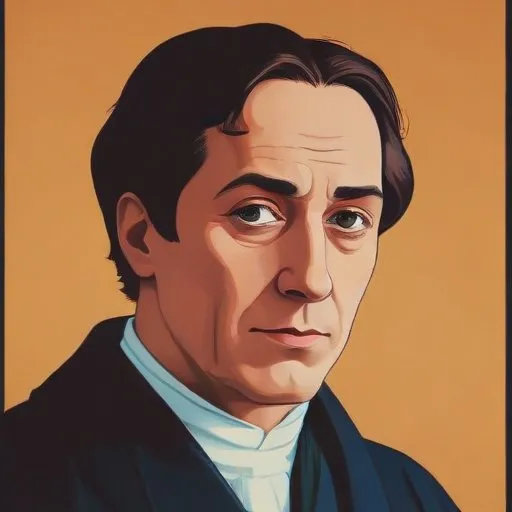
An Italian philosopher and painter who developed a unique blend of traditionalism, esotericism, and anti-modernism, influencing far-right and nationalist ideologies. His work spans metaphysics, politics, and art, with a focus on spiritual revival and critique of modern society.
Julius Evola, an Italian philosopher, is known for his extreme right-wing views, advocating for aristocratic, monarchist, and traditionalist ideologies that emphasize authority, hierarchy, and discipline. His works, infused with occultism, esotericism, and Eastern mysticism, have made him a prominent figure in the fascist and neofascist movements of the 20th century.
Born on May 19, 1898, in Rome, Italy, Evola served as an artillery officer in World War I. After the war, he delved into Dadaism, an art movement that emphasized chaos and nonsense, but eventually abandoned it in his twenties. A profound reading experience with Buddhist texts led him to renounce suicide and redirected his focus towards spirituality and philosophy.
In the 1920s, Evola immersed himself in the study of Western esotericism and Eastern mysticism, developing his doctrine of "magical idealism." This unique blend of philosophical ideas drew from German idealism, traditionalism, and the Conservative Revolution, incorporating themes such as:
Evola's philosophy revolves around the concept of the "Kali Yuga," a Dark Age characterized by materialism and moral decay. To counter this, he proposed a world of "Tradition," which emphasizes authority, hierarchy, order, discipline, and obedience. His thought system has been described by scholar Franco Ferraresi as "one of the most consistently antiegalitarian, antiliberal, antidemocratic, and antipopular systems in the twentieth century."
Evola's writings contain elements of misogyny, racism, antisemitism, and attacks on Christianity and the Catholic Church. He actively supported Fascist Italy's racial laws and eventually became Italy's leading racial philosopher. Autobiographical remarks suggest that he worked for the Sicherheitsdienst (SD), the intelligence agency of the SS.
Evola's ideas have influenced various far-right and neofascist movements, shaping the thought of prominent figures such as Alain de Benoist and Guillaume Faye. His writings continue to be debated and criticized by scholars, philosophers, and political commentators. Despite the controversy surrounding his views, Evola remains a significant figure in the history of 20th-century political philosophy.
"The world is not a concept, but a battlefield."
"The only true equality is in the struggle."
1898: Born in Rome, Italy
1917-1918: Served as an artillery officer in World War I
1920s: Delved into Dadaism and later abandoned it
1950s: Became a prominent figure in the neofascist movement
1974: Died on June 11th in Rome, Italy
| 1898 | Born in Rome, Italy |
| 1917-1918 | Served as an artillery officer in World War I |
| 1920s | Delved into Dadaism and later abandoned it |
| 1950s | Became a prominent figure in the neofascist movement |
| 1974 | Died on June 11th in Rome, Italy |
Born in 1886
A French-Egyptian philosopher and author who wrote extensively on spirituality, metaphysics, and traditionalism, critiquing modern Western society and advocating for a return to spiritual and intellectual traditions.
Born in 1875
A renowned occultist and mystic who wrote extensively on magic, mysticism, and thelema, and is often associated with the phrase "Do what thou wilt shall be the whole of the Law."
Born in 1917
A Chilean poet and diplomat who served as ambassador to India and wrote extensively on esoteric and spiritual topics, blending mysticism with fascist ideology.
Born in 1877
A renowned poet, novelist, and painter, celebrated for his thought-provoking and introspective works that explore the human condition, spirituality, and the search for meaning. His writings often blended elements of psychology, philosophy, and mysticism.
Born in 1875
Developed the concept of collective unconscious and archetypes, and founded analytical psychology, which emphasizes the integration of opposites and the process of individuation.
Born in 1889
A German philosopher and academic who explored the meaning of existence, time, and human existence, influencing 20th-century philosophy with his concept of "Being-in-the-world".
