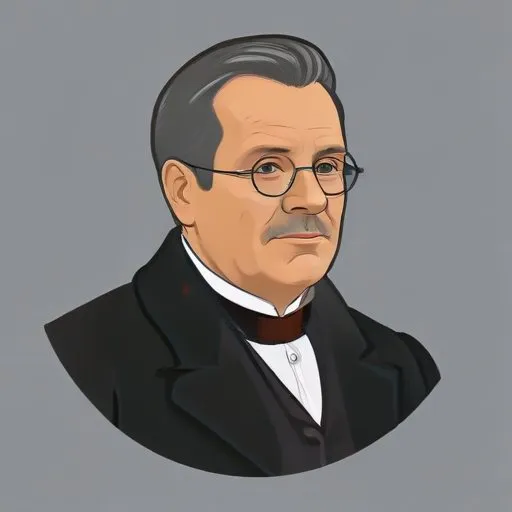
Julius Robert von Mayer: The Father of Thermodynamics
Julius Robert von Mayer, a German physician and physicist, is renowned for his groundbreaking work in the field of thermodynamics, particularly for being the first to enunciate the law of conservation of energy. His pioneering research laid the foundation for the development of modern physics, earning him a permanent place in the annals of scientific history.
Early Life and Education
Born on November 25, 1814, in Heilbronn, Kingdom of Württemberg, Mayer's fascination with science and mathematics was evident from an early age. He studied medicine at the University of Tübingen, where he earned his doctorate in 1838. After completing his studies, Mayer worked as a ship's doctor, which sparked his interest in the relationship between heat, work, and energy.
Thermodynamic Contributions
Mayer's most significant contribution was his formulation of the law of conservation of energy, which states that energy cannot be created or destroyed, only converted from one form to another. He published his findings in a paper titled "On the Motions of Organism and their Relation to Metabolism" in 1842. Mayer's work built upon the research of Sadi Carnot and paved the way for the development of the laws of thermodynamics by scientists like
Rudolf Clausius and William Thomson (Lord Kelvin).
Personal Milestones and Key Life Events
In 1841, Mayer married a woman named Berniece, with whom he had six children. He was known for his humility and kindness, often using his medical skills to treat the poor and underprivileged. Mayer's dedication to science and humanity earned him the respect and admiration of his peers.
Career Highlights and Major Works
- "On the Motions of Organism and their Relation to Metabolism" (1842) - Mayer's seminal paper on the law of conservation of energy
- "The Mechanical Equivalent of Heat" (1845) - A paper that demonstrated the convertibility of mechanical energy into heat
- "Die Organische Bewegung in ihrem Zusammenhange mit dem Stoffwechsel" (1867) - A comprehensive work on the relationship between organic motion and metabolism
Influence on Modern Society
Mayer's work on thermodynamics has had a profound impact on modern society, influencing fields such as:
- Engineering: His laws of thermodynamics are fundamental to the design and optimization of energy-efficient systems
- Physics: Mayer's work laid the foundation for the development of quantum mechanics and relativity
- Environmental Science: The concept of energy conservation is crucial in addressing global environmental challenges
Philosophical Contributions and Beliefs
Mayer's scientific philosophy was rooted in the idea that nature is governed by laws and principles that can be discovered through observation, experimentation, and mathematical analysis. He believed that a deep understanding of these principles could lead to a more harmonious relationship between humanity and the natural world.
Legacy and Honors
Mayer's contributions to science were recognized during his lifetime, and he was awarded several honors, including:
- Copley Medal (1871) - Awarded by the Royal Society for his outstanding contributions to science
- Pour le Mérite (1871) - A prestigious German honor for excellence in science and art
Trivia and Fun Facts
- Mayer was an avid music lover and played the piano in his spare time
- He was a strong advocate for the importance of science education in schools
- Mayer's work on thermodynamics was initially met with skepticism, but he persevered, and his theories were eventually widely accepted
Mayer's groundbreaking work on thermodynamics has left an indelible mark on the scientific community, and his legacy continues to inspire future generations of scientists and thinkers.
FAQ
What is Julius Robert von Mayers contribution to thermodynamics?
Julius Robert von Mayer is credited with discovering the law of conservation of energy, which states that energy cannot be created or destroyed, only converted from one form to another. His work on thermodynamics laid the foundation for modern physics.
Who influenced Julius Robert von Mayers work in physics?
Julius Robert von Mayer was heavily influenced by the works of Sadi Carnot, a French physicist, and James Joule, an English physicist, who also worked on the concept of energy conservation.
What awards did Julius Robert von Mayer receive for his work?
Julius Robert von Mayer was awarded the Copley Medal in 1871 by the Royal Society for his outstanding contributions to physics. He also received the Poncelet Prize in 1869 for his work on the mechanical equivalent of heat.
What is Julius Robert von Mayers most famous publication?
Julius Robert von Mayers most famous publication is his 1842 paper Bemerkungen über die Kräfte der unbelebten Natur (Remarks on the Forces of Inorganic Nature), which presented his ideas on the conservation of energy.
How did Julius Robert von Mayers work impact the development of modern technology?
Julius Robert von Mayers discovery of the law of conservation of energy had a significant impact on the development of modern technology, including the design of steam engines, refrigeration systems, and other energy-related technologies.