


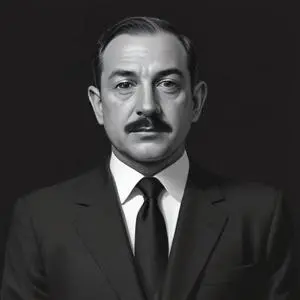
Convicted of espionage for passing nuclear secrets to the Soviet Union, this American spy's actions sparked intense controversy and debate about loyalty, patriotism, and national security.
Julius Rosenberg, along with his wife Ethel, was convicted of espionage in 1951 for conspiring to commit espionage on behalf of the Soviet Union. The couple was found guilty of providing top-secret information about American radar, sonar, jet propulsion engines, and nuclear weapon designs to the Soviet government.
Julius Rosenberg was born on May 12, 1918, in New York City to a family of Jewish immigrants from the Russian Empire. He grew up on the Lower East Side, where his parents worked in local shops. Rosenberg attended Seward Park High School and developed an interest in engineering and electronics.
Rosenberg worked as an engineer for the Army Signal Corps and later for Emerson Radio. During this time, he allegedly began recruiting spies and passing sensitive information to the Soviets. His wife, Ethel, was also involved in the spy ring, helping to recruit her brother, David Greenglass, and performing clerical tasks such as typing documents.
The Rosenbergs were arrested in 1950, and their trial began in 1951. The prosecution presented evidence, including testimony from David Greenglass and Harry Gold, a fellow spy, that implicated the couple in the espionage conspiracy. The defense argued that the government's case was based on circumstantial evidence and that the Rosenbergs were victims of Cold War paranoia. On April 5, 1951, the jury delivered a guilty verdict, and Judge Irving Kaufman sentenced the Rosenbergs to death.
Julius and Ethel Rosenberg were executed by electric chair on June 19, 1953, at Sing Sing Prison in Ossining, New York. The execution sparked widespread controversy, with many believing that the Rosenbergs were innocent and that their trial was unfair. The case remains one of the most notorious in American history, with ongoing debates about the couple's guilt and the government's handling of the case.
In the 1990s, the US government declassified information from the Venona project, which revealed Julius's role as a courier and recruiter for the Soviets. This evidence, along with other declassified documents, has led many to conclude that the Rosenbergs were, in fact, guilty of espionage. Despite this, their sons, Michael and Robert Meeropol, continue to argue that their parents were innocent and that the government's case was flawed.
"I am at peace with my conscience. I never betrayed my country. I never betrayed my people. I am proud of my heritage, and I am proud of my family." - Julius Rosenberg, in a statement before his execution
The Rosenberg case took place during a period of intense anti-communist sentiment in the United States, fueled by the Red Scare and McCarthyism. The trial and execution of the Rosenbergs remain a symbol of the paranoia and fear that characterized this era in American history.
Julius Rosenberg's legacy remains a complex and controversial topic, with ongoing debates about his guilt, the government's handling of the case, and the impact of the Cold War on American society.
Born in 1915
Convicted of espionage for passing nuclear secrets to the Soviet Union, this American spy's controversial execution sparked widespread debate about Cold War politics and government secrecy.
Born in 1911
A German-born physicist who contributed significantly to the development of the atomic bomb, while secretly passing nuclear secrets to the Soviet Union during the Cold War.
Born in 1904
A high-ranking government official turned Soviet spy, convicted of espionage in 1950, sparking a national scandal and Red Scare paranoia.
Born in 1901
A former Soviet spy who defected to the US, exposing communist infiltration in the government, and sparking a national debate on communism and loyalty.
