


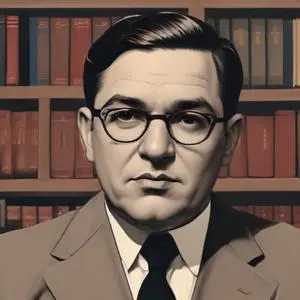
A former Soviet spy who defected to the US, exposing communist infiltration in the government, and sparking a national debate on communism and loyalty.
Whittaker Chambers, the American writer and intelligence agent, is best known for his dramatic defection from the Soviet underground in 1938 and his subsequent testimony in the Hiss case, a trial that would shake the foundations of American politics.
A former member of the Communist Party and Soviet spy, Chambers' conversion to conservatism and his expose of the Ware Group, a network of Soviet spies operating in the United States, made him a legend in his own time.
Born Jay Vivian Chambers in Philadelphia, Pennsylvania, in 1901, Whittaker grew up in a troubled home, marked by his parents' separation and their need to care for his mentally ill grandmother.
After graduating from South Side High School in 1919, Chambers worked itinerantly in Washington and New Orleans, briefly attending Williams College before enrolling at Columbia College of Columbia University.
It was during his time at Columbia that Chambers became radicalized, drawn to communism as a way to escape the chaos of his childhood and find meaning in a dying world.
Chambers joined the Communist Party in 1925 and soon became a Soviet spy, using his position as a writer and editor to gather intelligence and funnel information to the Soviet Union.
For nearly a decade, Chambers operated as a spy, passing sensitive documents to his Soviet handlers and living a double life, all the while hiding his true allegiance from his friends and family.
In 1938, Chambers defected from the Soviet underground, citing his growing disillusionment with the brutality and oppression of the Stalin regime.
After defecting, Chambers began working as a senior editor at Time magazine, but his most significant contribution came in 1949, when he testified against Alger Hiss, a high-ranking government official accused of being a Soviet spy.
Chambers' testimony, which included his famous observation that "the puzzle of history is largely a puzzle of the human heart," helped secure Hiss' conviction and cemented Chambers' reputation as a courageous and principled whistleblower.
In 1952, Chambers published his memoir, Witness, a bestselling account of his life as a spy and his subsequent conversion to conservatism.
The book became a classic of American literature, praised for its lyrical prose and its searing indictment of communism as a morally bankrupt ideology.
Witness has been hailed as one of the most important books of the 20th century, a testament to the power of individual courage and conviction in the face of overwhelming odds.
In 1984, President Ronald Reagan posthumously awarded Chambers the Presidential Medal of Freedom, the highest civilian honor in the United States.
Chambers' legacy extends far beyond his own life, inspiring generations of writers, thinkers, and politicians to stand up against tyranny and fight for the values of freedom and democracy.
Today, Whittaker Chambers remains an enigmatic figure, a complex and multifaceted individual whose life continues to fascinate and inspire.
"The puzzle of history is largely a puzzle of the human heart."
"Faith is the direct accountability of the soul to God."
"The crisis of the West is the crisis of faith."
Born in 1904
A high-ranking government official turned Soviet spy, convicted of espionage in 1950, sparking a national scandal and Red Scare paranoia.
Born in 1913
The 37th President of the United States, a polarizing figure who led the country through significant domestic and foreign policy changes, infamous for his involvement in the Watergate scandal.
Born in 1908
A zealous anti-communist who led a crusade against alleged communist infiltration in the US government, sparking a wave of paranoia and witch hunts in the 1950s.
99 Years Old
A ruthless and influential lawyer who played a significant role in the Red Scare of the 1950s, known for his aggressive tactics and close ties to powerful politicians.
Born in 1895
The first Director of the FBI, who led the agency for nearly five decades, building it into a powerful force in American law enforcement, and notorious for his secretive and authoritarian style. He's infamous for his surveillance and harassment of political dissidents, civil rights leaders, and celebrities.
Born in 1890
Led the Allied forces to victory in World War II and later served as President, maintaining peace and prosperity during the Cold War era. He's known for his strategic leadership and diplomatic skills.
Born in 1917
The 35th President of the United States was a charismatic leader who navigated the country through the Cuban Missile Crisis and advocated for civil rights, leaving a lasting legacy in American politics.
Born in 1925
A Navy officer, lawyer, and politician who served as US Attorney General, playing a key role in the Civil Rights Movement and advocating for social justice. He was a prominent figure in American politics during the 1960s.
