


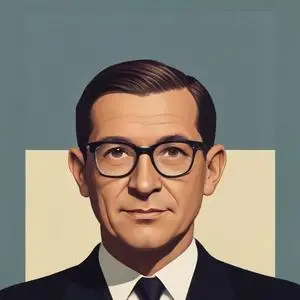
A high-ranking government official turned Soviet spy, convicted of espionage in 1950, sparking a national scandal and Red Scare paranoia.
Alger Hiss, a complex and intriguing figure, is best known for being accused of spying for the Soviet Union in the 1930s, sparking a maelstrom of controversy that reverberated throughout the Cold War era. His high-profile trial and subsequent conviction for perjury in 1950 cemented his place in American history, raising questions about loyalty, betrayal, and the limits of political ideology.
Born on November 11, 1904, in Baltimore, Maryland, Hiss came from a family of modest means. He graduated from Johns Hopkins University in 1926 and later attended Harvard Law School, where he earned his law degree in 1929. Hiss's early career saw him work as a lawyer in New York City before joining the U.S. State Department in 1933.
Hiss's career flourished during the 1930s and 1940s, as he played a key role in shaping international relations. He was a prominent figure in the establishment of the United Nations, serving as a U.S. State Department official and later as a UN official. His involvement in the UN's early years earned him widespread recognition and respect.
The trajectory of Hiss's life took a dramatic turn on August 3, 1948, when Whittaker Chambers, a former U.S. Communist Party member, testified before the House Un-American Activities Committee (HUAC) that Hiss had secretly been a communist while in federal service. Hiss vehemently denied the charge, and the ensuing libel case led to the discovery of new evidence, which would ultimately result in his indictment on two counts of perjury.
The first trial ended in a hung jury, but the second trial, in 1950, resulted in a guilty verdict. Hiss was sentenced to two concurrent five-year sentences, of which he served three and a half years. The controversy surrounding his case sparked heated debates about the Cold War, McCarthyism, and the extent of Soviet espionage in the United States.
Since Hiss's conviction, the debate about his guilt or innocence has continued to simmer. In the 1990s, two former senior Soviet military officers responsible for the Soviet Union's military intelligence archives stated that they found no evidence of Hiss's involvement with Soviet intelligence. Conversely, the 1995 Venona Papers provided evidence supporting the theory that Hiss was a Soviet spy. The controversy endures, with many questions about Hiss's true loyalties remaining unanswered.
The Alger Hiss case has left an indelible mark on American history, serving as a symbol of the fears and anxieties of the Cold War era. His story has been the subject of numerous books, films, and documentaries, ensuring his place in the popular imagination. Despite the controversy, Hiss's contributions to international relations and his role in shaping the United Nations cannot be ignored.
"I am proud to have served my country in the State Department and the United Nations, and I am proud to have been part of the effort to promote peace and understanding between nations." – Alger Hiss
Alger Hiss's enigmatic life and career continue to fascinate and intrigue, serving as a reminder of the complexities and controversies of the Cold War era.
Born in 1901
A former Soviet spy who defected to the US, exposing communist infiltration in the government, and sparking a national debate on communism and loyalty.
Born in 1913
The 37th President of the United States, a polarizing figure who led the country through significant domestic and foreign policy changes, infamous for his involvement in the Watergate scandal.
Born in 1890
Led the Allied forces to victory in World War II and later served as President, maintaining peace and prosperity during the Cold War era. He's known for his strategic leadership and diplomatic skills.
Born in 1908
A zealous anti-communist who led a crusade against alleged communist infiltration in the US government, sparking a wave of paranoia and witch hunts in the 1950s.
Born in 1888
A prominent Cold War diplomat who served as Secretary of State under President Dwight D. Eisenhower, known for his anti-communist foreign policy and role in shaping the United States' response to the Soviet Union.
Born in 1893
The 5th Director of Central Intelligence was a master spy and diplomat who oversaw the CIA during the Cold War, orchestrating covert operations and shaping global politics. He's infamous for his role in the Bay of Pigs invasion and CIA-led coups.
Born in 1893
A pioneering scientist who discovered deuterium, a heavy isotope of hydrogen, and later contributed to the discovery of many other elements, revolutionizing our understanding of the universe.
Born in 1835
The 23rd Vice President of the United States was a skilled lawyer and politician who served under President Grover Cleveland from 1893 to 1897, known for his strong oratory skills and progressive policies. He played a key role in shaping the country's foreign policy during his tenure.
