


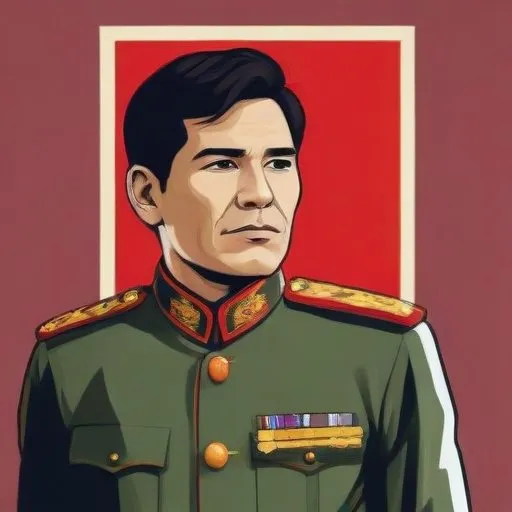
Peruvian soldier and politician who served as the 57th President of Peru, known for his military background and brief tenure in office. He played a significant role in Peru's political landscape during a tumultuous period.
Justiniano Borgoo Castañeda, a Peruvian soldier and politician, is best known for his brief yet pivotal tenure as the Interim Caretaker of Peru, serving as the President of the Government Junta in 1894. During this tumultuous period, Borgoo demonstrated remarkable leadership, stabilizing the country and paving the way for future generations of Peruvian leaders.
Born on September 5, 1836, in Trujillo, Peru, Borgoo embarked on a military career at a young age, fighting in the War of the Pacific. His bravery and strategic acumen earned him recognition, leading to his involvement in politics as a member of the Constitutional Party.
In 1890, Borgoo assumed the role of Second Vice President, a position that catapulted him to the forefront of Peruvian politics. Following the untimely death of Remigio Morales Bermúdez in 1894, Borgoo was appointed as the Interim Caretaker of Peru, tasked with maintaining order and stability until the next election.
During his brief tenure, Borgoo faced numerous challenges, including the aftermath of the War of the Pacific and the country's fragile economic state. Despite these obstacles, he demonstrated remarkable resilience and leadership, ensuring a peaceful transition of power to his successor, Andrés Avelino Cáceres.
Justiniano Borgoo Castañeda's personal life remains somewhat enigmatic, with limited information available about his family and personal relationships. However, his contributions to Peruvian politics and his dedication to the country's well-being are undeniable.
Borgoo's legacy extends beyond his brief tenure as Interim Caretaker. He played a pivotal role in shaping Peru's political landscape, paving the way for future leaders to build upon. His commitment to stability and order in times of turmoil has earned him a place in Peruvian history, as a testament to his unwavering dedication to his country.
| Year | Event |
|---|---|
| 1836 | Born in Trujillo, Peru |
| 1890 | Becomes Second Vice President of Peru |
| 1894 | Becomes Interim Caretaker of Peru |
| 1894 | Hands over power to Andrés Avelino Cáceres |
| 1921 | Passes away in Lima, Peru |
Justiniano Borgoo Castañeda's life was marked by his unwavering commitment to Peru and its people. Though his tenure as Interim Caretaker was brief, his impact on Peruvian politics and history remains significant, earning him a place among the country's most notable leaders.
Born in 1836
Peruvian general and president who led the country to victory in the War of the Pacific and later became a national hero. He's known for his military prowess and patriotic leadership.
Born in 1912
Peruvian architect and politician who served as President of Peru, implementing significant economic and social reforms, and promoting national identity through architecture.
77 Years Old
The first democratically elected president of Peru to serve two non-consecutive terms, known for implementing neoliberal economic policies and facing corruption allegations.
88 Years Old
Peruvian engineer, academic, and politician who served as the 90th President of Peru, known for his authoritarian rule and controversial policies, including forced sterilizations and human rights abuses.
80 Years Old
Peruvian economist and politician who served as President of Peru from 2001 to 2006, known for implementing economic reforms and promoting social programs. He's also recognized for his indigenous roots and advocacy for Andean communities.
