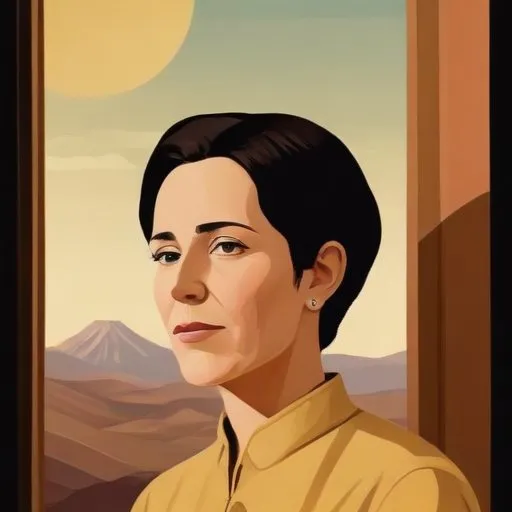
Kay Sage

Kay Sage

Kay Sage was born on June 25th, 1898

Full Name: Kay Sage
Nationality: American
Profession: Painter, Poet
Born: June 25, 1898
Died: January 8, 1963
Known For: Surrealist art
Place of Birth: Albany, New York
Husband: Yves Tanguy

A surrealist painter and poet who explored the intersection of art and language, creating dreamlike landscapes and abstract forms that evoke a sense of mystery and introspection.

Written by: Carlos Hernandez Carlos Hernandez

A Pioneer of Architectural Surrealism

Kay Sage, a prominent American Surrealist artist and poet, is renowned for her captivating works that typically feature architectural themes. Born on June 25, 1898, in Albany, New York, Sage's artistic career spanned from 1936 to 1963, during which she made significant contributions to the Surrealist movement.

Early Life and Influences

Born into a wealthy family, Sage's early life was marked by frequent travels to Europe with her mother, Anne Wheeler Ward Sage. This exposure to diverse cultures and languages instilled in her a deep appreciation for the arts. Sage became fluent in French and Italian, skills that would later influence her artistic style. Her mother's encouragement of her creative pursuits led Sage to develop a passion for drawing and writing from a young age.

Artistic Training and Development

Sage's formal training in painting began at the Corcoran Art School in Washington, D.C. (1919-1920). She later studied art in Rome, where she mastered conventional techniques and styles. However, it was her affiliation with the Surrealist movement that truly defined her artistic voice.

Major Works and Themes

Sage's artistic oeuvre is characterized by its use of architectural elements, often featuring dreamlike landscapes with mysterious structures and perspectives. Her paintings, such as "The Unseen" (1942) and "I Saw Three Cities" (1944), showcase her ability to blend realism with the surreal. Through her work, Sage explored themes of isolation, entropy, and the relationship between nature and architecture.

Influence on Modern Surrealism

As a member of the Golden Age and Post-War periods of Surrealism, Sage's work had a profound impact on the development of the movement. Her unique style, which blended architectural elements with surrealistic themes, inspired a generation of artists. Her contributions to the Surrealist movement, alongside other notable artists like Salvador Dalí and André Breton, helped shape the genre's aesthetic and themes.

Personal Life and Marriage

In 1925, Sage married an Italian prince, becoming the Princess of San Faustino. This union not only granted her royal status but also introduced her to the aristocratic circles of Europe. Her marriage, however, was not without controversy, and Sage's royal status has been the subject of much speculation and debate.

Legacy and Impact

Kay Sage's artistic legacy extends beyond her own oeuvre, influencing generations of Surrealist artists and poets. Her unique style, which blended architectural elements with surrealistic themes, continues to inspire artists, architects, and designers to this day. Through her work, Sage has left an indelible mark on the history of Surrealism, cementing her place as one of the movement's most innovative and enigmatic figures.

Trivia and Fun Facts

By exploring the life and works of Kay Sage, we gain insight into the fascinating world of Surrealist art and the pioneering spirit of this enigmatic artist. Her legacy serves as a testament to the power of creativity and innovation, inspiring future generations to push the boundaries of art and imagination.
Timeline
1898
Born in Albany
Kay Sage was born on June 25, 1898, in Albany, New York, USA.
1919
Moved to Europe
Sage moved to Europe, where she studied art and began her career as a painter.
1937
Met Yves Tanguy
Sage met Yves Tanguy, a French surrealist painter, and the two began a romantic relationship.
1940
Moved to the United States
Sage and Tanguy moved to the United States, where they continued to paint and exhibit their work.
1963
Died in Connecticut
Kay Sage died on January 8, 1963, in Woodbury, Connecticut, USA, at the age of 64.
Kay Sage

Kay Sage Quiz

What style of art is Kay Sage most associated with?

Score: 0/5
FAQ
What was Kay Sages significance in American art?
Kay Sage was a pioneering American painter and poet who played a significant role in shaping American art. She was a key figure in the development of Surrealism in the United States and was known for her innovative use of color and form.
What themes did Kay Sage explore in her artwork?
Kay Sages artwork explored a range of themes, including the relationship between reality and fantasy, the power of the human imagination, and the fragility of the human psyche. Her work was characterized by its lyricism, introspection, and emotional depth.
How did Kay Sages work reflect her American heritage?
Kay Sages work was deeply rooted in American culture and landscape. She drew inspiration from the American West, the desert landscape, and the myths and legends of the American people.
What was Kay Sages relationship with Yves Tanguy?
Kay Sage was married to Yves Tanguy, a French Surrealist painter. The two artists shared a deep creative and emotional bond, and their work was deeply intertwined. They influenced each others artistic styles and supported each others creative endeavors.
What legacy did Kay Sage leave behind?
Kay Sages legacy is that of a visionary artist who helped to shape American Surrealism. Her work continues to inspire artists, poets, and writers today, and her innovative approach to art and literature remains an important part of American cultural heritage.

Related People:

Yves Tanguy

Born in 1900

A surrealist painter who created dreamlike, fantastical landscapes with melting objects and eerie atmospheres, blurring the line between reality and fantasy.

Max Ernst

Born in 1891

A pioneering figure in Surrealism, creating dreamlike, fantastical works that blurred reality and the subconscious, influencing generations of artists.

André Breton

Born in 1896

French poet and author who founded Surrealism, a cultural movement that explored the subconscious and the world of dreams. He wrote novels, poems, and essays that continue to influence art and literature today.

Salvador Dalí

Born in 1904

A renowned surrealist master of bizarre, dream-like paintings and sculptures that blur reality and fantasy, known for iconic works like "The Persistence of Memory" and "The Elephants".

René Magritte

Born in 1898

A Belgian surrealist painter who challenged perceptions by depicting everyday objects in unexpected contexts, creating thought-provoking and witty visual paradoxes.

Man Ray

Born in 1890

A pioneer of avant-garde photography, this artist experimented with techniques like solarization and rayography, creating surreal, dreamlike images that blurred the line between art and photography.

Lee Miller

Born in 1907

A pioneering model-turned-photographer who captured intimate portraits of WWII soldiers and later became a renowned war correspondent, known for her striking images and fearless approach.

Dorothea Tanning

Born in 1910

A pioneering Surrealist artist, known for her dreamlike, symbolic paintings and sculptures that explored the realms of the subconscious, as well as her poetry that delved into the human psyche.