


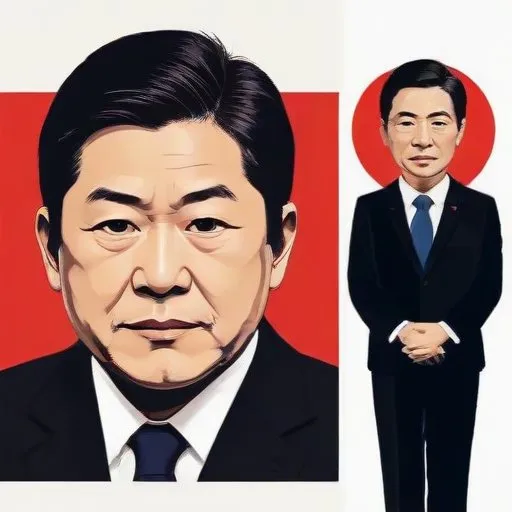
A Japanese politician who served as the Minister of Justice, known for his efforts to reform the country's justice system and address human rights issues.
Keishu Tanaka, a Japanese politician, served as a member of the Democratic Party in the House of Representatives in the Diet, Japan's national legislature. He is infamous for his short-lived tenure as Minister of Justice under Prime Minister Yoshihiko Noda from October 1 to 23, 2012, which was marred by scandals over financial donations and organized crime links.
Born on March 6, 1938, in Soma District, Fukushima, Tanaka graduated from Tokai University. He entered politics in 1983, marking the beginning of a three-decade-long political career. Throughout his tenure, he served in various capacities, including as a member of the Diet and a cabinet minister.
Tanaka's appointment as Minister of Justice on October 1, 2012, came as part of Prime Minister Yoshihiko Noda's third cabinet lineup. In this role, he was also responsible for addressing the abduction issue, succeeding Jin Matsubara.
On October 4, 2012, Tanaka admitted to receiving 420,000 yen in donations from a Taiwanese company between 2006 and 2009. This revelation sparked controversy, as it violated the Political Funds Control Act of 1948, which prohibits politicians from accepting donations from foreign individuals and organizations. Although Tanaka returned the donations on October 3, 2012, he faced intense scrutiny, leading to his eventual resignation on October 23, 2012.
In a shocking expose, the weekly magazine Shukan Shincho reported on October 11, 2012, that Tanaka had connections to the Inagawakai yakuza syndicate 30 years prior. The report alleged that Tanaka had attended a party hosted by a yakuza boss, made a speech, and even acted as a matchmaker for an executive member of the group. Tanaka denied using the yakuza for personal gains or to mediate their disputes, claiming he would not have taken those actions if he had known of their connections.
Tanaka's political career was marked by controversies, scandals, and ultimately, his resignation. Despite his fall from grace, his tenure as Minister of Justice highlighted the need for greater transparency and accountability in Japanese politics. Tanaka's story serves as a cautionary tale on the dangers of political corruption and the importance of upholding ethical standards in public office.
85 Years Old
A Japanese target shooter turned politician who served as the country's 92nd Prime Minister, known for his brief yet tumultuous tenure marked by scandals and controversies.
69 Years Old
The 62nd Prime Minister of Japan, a lawyer-turned-politician who led the country from 2011 to 2012, known for his efforts to rebuild Japan after the devastating Fukushima nuclear disaster. He's also recognized for increasing the country's consumption tax to tackle its massive debt.
79 Years Old
The 61st Prime Minister of Japan, a lawyer-turned-politician who led the country during the 2011 Fukushima Daiichi nuclear disaster, implementing reforms and advocating for renewable energy. He's known for his efforts to phase out nuclear power and promote sustainable energy.
79 Years Old
A Japanese engineer-turned-politician who served as Prime Minister of Japan from 2009 to 2010, known for his efforts to reform the country's economy and politics.
84 Years Old
A Japanese lawyer and politician who served as Minister of Home Affairs, known for his influential role in shaping the country's politics and economy. He's a key figure in Japan's post-war political landscape.
84 Years Old
The 56th Prime Minister of Japan, serving from 2001 to 2006, known for his economic reforms, privatization of the postal system, and bold foreign policy initiatives. He's also famous for his flamboyant hairstyle and love of Elvis Presley music.
