


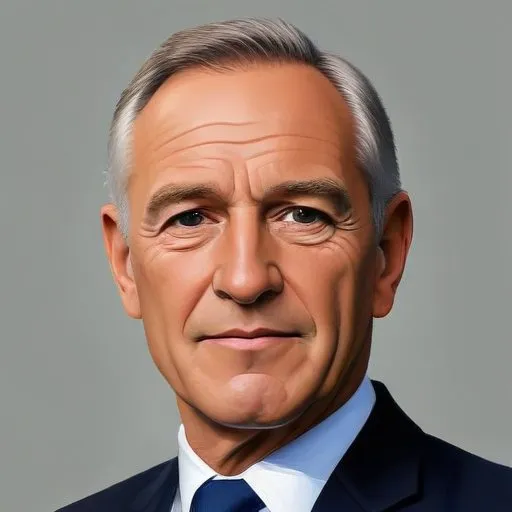
A farmer-turned-politician who served as Prime Minister of New Zealand, known for his leadership during a period of significant economic and social change. He's remembered for his pragmatic and consensus-driven approach to governance.
Sir Keith Jacka Holyoake, the 26th Prime Minister of New Zealand, served the nation for a brief period in 1957 and then from 1960 to 1972, leaving an indelible mark on its political landscape. He is the only New Zealander to have held both the positions of Prime Minister and Governor-General, serving as the 13th Governor-General from 1977 to 1980.
Born on February 11, 1904, near Pahiatua in the Wairarapa, Holyoake left formal education at the tender age of 12 to help on the family farm. His early life was shaped by the rugged realities of rural New Zealand, instilling in him a strong work ethic and a deep connection with the land.
Before entering politics, Holyoake was active in various local farming associations, which provided him with a platform to advocate for the interests of rural communities. His early involvement in politics led to his election to Parliament in 1932, representing the Motueka electorate for the conservative Reform Party.
Holyoake played a pivotal role in the formation of the National Party in 1936, which would go on to become a dominant force in New Zealand politics. Although he lost his seat two years later, he was soon earmarked for the safe seat of Pahiatua, which he held from 1943.
Following National's first election victory, Holyoake entered Cabinet in 1949 and was appointed the first Deputy Prime Minister of New Zealand in 1954, serving under Sidney Holland. This marked the beginning of his ascent to the highest echelons of power in New Zealand.
Holyoake became the leader of the National Party and Prime Minister in 1957, following Sidney Holland's resignation due to ill health. Although his initial tenure was brief, he returned to power in 1960 and led the country for over a decade, earning him a reputation as a shrewd politician and a master strategist.
During his time in office, Holyoake's government introduced significant reforms, including the rewriting of the criminal legal code through the Crimes Act 1961, which abolished capital punishment, and introduced a form of voluntary unionism. He also maintained a strong alliance with the United States and sent troops to Vietnam.
Sir Keith Holyoake was knighted in 1970 for his services to politics and the people of New Zealand. He received the highest honor in 1977, when he was appointed the 13th Governor-General of New Zealand, serving until 1980.
Holyoake resigned as Prime Minister in 1972 to ease the succession for his deputy and friend, Jack Marshall. He passed away on December 8, 1983, leaving behind a legacy of statesmanship, political acumen, and a deep commitment to the people of New Zealand.
Throughout his life, Holyoake remained dedicated to his family and rural roots. He was a passionate advocate for the interests of rural communities and worked tirelessly to promote the welfare of New Zealand's farmers.
Sir Keith Holyoake's legacy extends beyond his political achievements. He played a crucial role in shaping New Zealand's modern society, from its economy and politics to its social fabric and cultural identity.
His government's reforms, although often controversial, helped lay the groundwork for New Zealand's modern political landscape. His leadership and vision continue to inspire future generations of politicians, policymakers, and citizens.
In conclusion, Sir Keith Jacka Holyoake was a statesman, a leader, and a champion of the people. His remarkable life and achievements serve as a testament to the power of dedication, hard work, and a commitment to public service.
74 Years Old
A renowned cancer researcher and professor who made significant contributions to the understanding and treatment of cancer, particularly in the field of p53 tumor suppressor gene.
91 Years Old
The 35th Prime Minister of New Zealand, serving from 1990 to 1997, known for leading the country through significant economic reforms and free trade agreements. He's also recognized for his role in shaping New Zealand's modern economy.
74 Years Old
The first female Prime Minister of New Zealand, serving from 1997 to 1999, known for her conservative economic policies and reform efforts. She played a significant role in shaping the country's social and economic landscape.
76 Years Old
The first female Prime Minister of New Zealand, serving three consecutive terms from 1999 to 2008, known for her progressive policies and commitment to social justice.
82 Years Old
A German-Canadian singer-songwriter, guitarist, and producer, known for his eclectic style blending rock, folk, and blues, and as the frontman of the rock band Steppenwolf. He's famous for hits like "Born to Be Wild" and "Magic Carpet Ride".
64 Years Old
A farmer-turned-politician who served as the Prime Minister of New Zealand from 2016 to 2017, known for his efforts to reduce poverty and improve the country's economy.
77 Years Old
Leader of the New Zealand Labour Party, serving as Prime Minister from 1990 to 1991, known for his strong union background and advocacy for workers' rights.
84 Years Old
The 33rd Prime Minister of New Zealand, serving from 1989 to 1990, known for his leadership during a period of significant economic and social reform in the country. He played a crucial role in shaping New Zealand's modern economy and society.
