


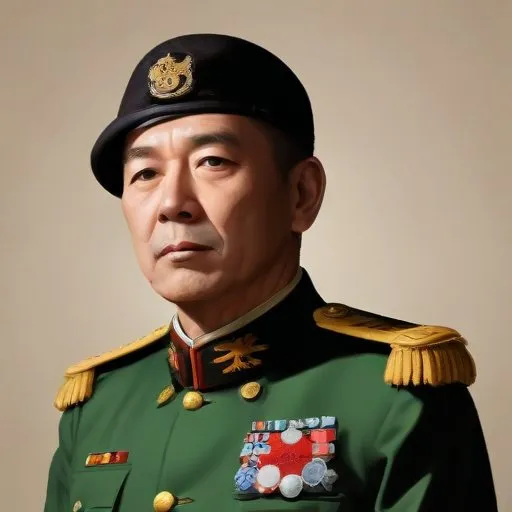
A high-ranking officer in the Imperial Japanese Army during World War II, known for leading the invasion of Hong Kong and later becoming a key figure in the Japanese occupation of Indonesia.
Kesago Nakajima is a name etched in the annals of history, synonymous with the brutal and devastating Nanjing Massacre that occurred in 1937 during the Second Sino-Japanese War. As a lieutenant general in the Imperial Japanese Army, Nakajima played a significant role in the atrocities committed during this dark period, earning him a notorious reputation that would haunt him for the rest of his life.
Nakajima was born on June 15, 1881, in Oita prefecture, Japan. He attended military preparatory schools as a youth and graduated from the 15th class of the Imperial Japanese Army Academy in 1903. Nakajima's military career spanned over three decades, during which he saw combat in the Russo-Japanese War and later served as a military attaché in France from 1918 to 1923.
Nakajima's star rose rapidly in the Imperial Japanese Army, and he was promoted to major general in 1932. He went on to command the Maizuru Army District, responsible for the defenses of Honshu's coast along the Sea of Japan. In 1933, he became commandant of the Narashino Chemical Warfare School, a position he held until 1936.
In 1936, Nakajima was promoted to lieutenant general and appointed a Provost Marshal. It was during this time that he played a pivotal role in the Second Sino-Japanese War, particularly in the Battle of Nanjing. As Operational Commander, Nakajima was directly responsible for the atrocities committed by Japanese forces, including the massacres, rapes, and looting that occurred in Nanjing.
According to accounts, Nakajima personally lent his sword to be used in the killings, and was seen laughing as he and his men carried out the atrocities. The exact number of casualties during the Nanjing Massacre is still debated, but estimates range from 150,000 to 300,000 civilians and prisoners of war killed.
After the Nanjing Massacre, Nakajima went on to participate in the Battle of Wuhan and later commanded the Japanese Fourth Army in Manchukuo from 1938 to 1939. He retired in September 1939 and died of illness on October 28, 1945, just a few months after Japan's surrender in World War II.
Nakajima's legacy is one of infamy, with his name forever linked to the brutalities committed during the Nanjing Massacre. His actions continue to be studied by historians and scholars, serving as a haunting reminder of the devastating consequences of war and the importance of upholding human rights.
Kesago Nakajima's life serves as a stark reminder of the devastating consequences of war and the importance of humanity in the face of conflict. His legacy continues to be felt today, serving as a cautionary tale for generations to come.
"I laughed as I and my men carried out the massacres." - Kesago Nakajima
These words, attributed to Nakajima, are a haunting reminder of the brutality and callousness that defined his actions during the Nanjing Massacre.
The Nanjing Massacre, and Nakajima's role in it, have had a profound impact on modern society. The atrocities committed during this period have led to increased awareness of the importance of human rights, international law, and the need for accountability in the face of war crimes.
The legacy of Kesago Nakajima serves as a reminder of the devastating consequences of war and the importance of promoting peace, understanding, and cooperation in the face of conflict.
Born in 1884
Led the Imperial Japanese Navy during World War II, masterminding the surprise attack on Pearl Harbor, and later became a symbol of Japanese military power and strategy.
Born in 1901
The Japanese emperor who ruled from 1926 to 1989, leading the country through World War II and its post-war reconstruction, and is known for his symbolic role in Japanese politics and culture. He is also remembered for his rare public apology for Japan's wartime atrocities.
Born in 1887
A Japanese general who led the invasion of the Philippines during World War II and was later tried for war crimes, known for his role in the Bataan Death March.
Born in 1885
A Japanese general who led the invasion of Malaya and the Philippines during World War II, known for his brutal tactics and war crimes. He was later tried and executed for his atrocities.
