


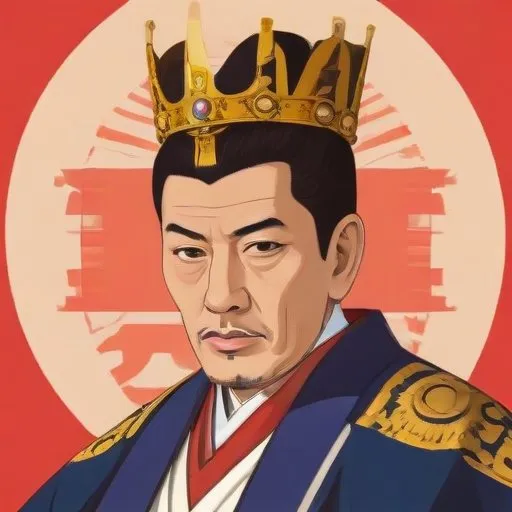
The 42nd emperor of Japan, who reigned from 393 to 405 and is known for his efforts to centralize imperial power and establish a strong, stable government. He's also famous for his legendary beauty and poetic talent.
Emperor Kgon, also known as Kgontenn, was the first emperor of the Northern Court during the Period of the Northern and Southern Courts in Japan, reigning from 1331 to 1333. He is remembered for his role in establishing the Northern Court, a rival court to the Southern Court, and his efforts to unite the country under a single imperial government.
Before his ascension to the throne, Kgon's personal name was Kazuhitoshinn. He was the third son of Emperor GoFushimi of the Jimyin line and was adopted by his uncle, Emperor Hanazono. His mother was Kgimonin Neishi, and he had several siblings and children throughout his life.
Kgon's reign spanned from October 22, 1331, to July 7, 1333. During this time, he was recognized as the legitimate emperor by the Kamakura shogunate, which had decided to alternate the throne between the Daikakuji and Jimyin lines. Kgon was named Crown Prince and heir to Emperor GoDaigo of the Daikakuji line in 1326.
Kgon had several wives and children throughout his life. His wives included Empress Imperial Princess Yoshiko, later known as Senseimonin, who was the daughter of Emperor GoDaigo; Consort Imperial Princess Hisako, later known as Kianmonin, who was the daughter of Emperor Hanazono; and Lady-in-waiting Sanj Shshi, later known as Yrokumonin, who was the daughter of Ogimachi Sanjo Kinhide.
Kgon's legacy lies in his role as the first emperor of the Northern Court, which he established in opposition to the Southern Court. Although his reign was short-lived, he played a significant role in Japanese history, as his actions helped to shape the country's imperial system.
In conclusion, Emperor Kgon was a pivotal figure in Japanese history, known for his role in establishing the Northern Court and his efforts to unite the country under a single imperial government. His reign, although short, had a lasting impact on the country's development.
| Year | Event |
|---|---|
| 1313 | Birth of Emperor Kgon |
| 1326 | Named Crown Prince and heir to Emperor GoDaigo |
| 1331 | Reign begins |
| 1333 | Reign ends |
| 1364 | Death of Emperor Kgon |
Born in 1377
The 100th emperor of Japan, who reigned from 1382 to 1412, is most known for his efforts to unify the Northern and Southern Courts, ending a 56-year period of division in Japan. He's also famous for his cultural achievements, including the promotion of Zen Buddhism and the arts.
Born in 1288
The 96th emperor of Japan, who led a rebellion against the Kamakura shogunate and attempted to restore imperial power, known for his efforts to reform the government and promote cultural development.
