


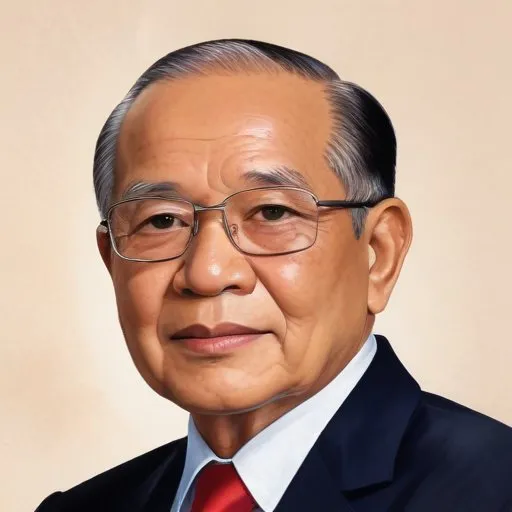
The 28th Prime Minister of Cambodia, a key figure in the Khmer Rouge regime, known for his role in the brutal regime that led to the deaths of millions of people. He was later convicted of crimes against humanity.
Khieu Samphan, the former chairman of the state presidium of Democratic Kampuchea, is a name synonymous with one of the darkest periods in Cambodian history. From 1976 to 1979, Samphan served as the country's head of state, making him one of the most powerful officials in the Khmer Rouge movement, second only to Pol Pot.
Born on July 28, 1931, in Svay Rieng Province, Cambodia, Samphan came from a Khmer-Chinese family. His father, Khieu Long, was a judge under the French Protectorate government, while his mother, Por Kong, was of Chinese descent. After his father's imprisonment for corruption, Samphan's mother took on the responsibility of providing for the family, selling fruits and vegetables in Kampong Cham Province.
Despite these humble beginnings, Samphan's academic prowess earned him a seat at the prestigious Lyce Sisowath. He later traveled to France, where he pursued his university studies in Economics at the University of Montpellier and eventually earned a PhD at the University of Paris.
In the 1950s, Samphan became part of a circle of leftist Khmer intellectuals studying at the Sorbonne in Paris. His 1959 doctoral thesis, "Cambodia's Economy and Industrial Development," laid the groundwork for his future involvement with the Khmer Rouge.
Before joining the Khmer Rouge, Samphan was a member of Norodom Sihanouk's Sangkum government. However, after the 1967 leftist rebellion, Sihanouk ordered the arrest of leftists, including Samphan, who fled into hiding until the Khmer Rouge takeover in 1975.
As the head of state, Samphan played a significant role in the Khmer Rouge's brutal regime, which was marked by forced labor, mass executions, and the infamous "killing fields." The regime's policies led to the deaths of an estimated 1.7 to 2.2 million people, out of a population of approximately 8 million.
In 2014, Samphan was convicted and received a life sentence for crimes against humanity during the Cambodian genocide. A further trial in 2018 found him guilty of genocide.
As the oldest living former prime minister and the last surviving senior member of the Khmer Rouge, Samphan's legacy is one of controversy and tragedy. His role in the regime's atrocities has left an indelible mark on Cambodia's history.
Despite his conviction, Samphan has maintained that he was unaware of the atrocities committed during the regime. However, his contributions to the Khmer Rouge's economic policies and his position of power make him a complicit figure in one of the darkest chapters of the 20th century.
Today, Samphan remains imprisoned, a testament to the long road to justice and accountability for the victims of the Khmer Rouge regime.
Born in 1925
The brutal leader of the Khmer Rouge regime, responsible for the deaths of an estimated 1.5 to 3 million people, through forced labor, mass executions, and torture, during his rule from 1975 to 1979.
Born in 1922
The former King and Prime Minister of Cambodia who led the country to independence from France and later navigated its tumultuous politics, known for his charismatic leadership and diplomatic skills.
Born in 1925
Co-founder of the Khmer Rouge, a brutal regime responsible for the deaths of an estimated 1.5 to 3 million people in Cambodia during the 1970s. Known for implementing radical social and economic policies that led to widespread atrocities.
Born in 1926
A chief ideologist and second-in-command of the Khmer Rouge regime, responsible for implementing radical social and economic policies that led to the deaths of millions of people.
