


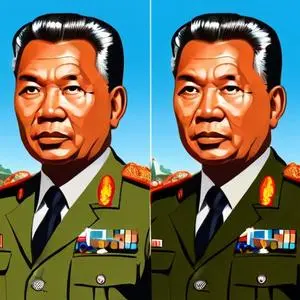
The brutal leader of the Khmer Rouge regime, responsible for the deaths of an estimated 1.5 to 3 million people, through forced labor, mass executions, and torture, during his rule from 1975 to 1979.
Pol Pot, the infamous Cambodian dictator, is known for his brutal regime that orchestrated the Cambodian genocide, resulting in the deaths of an estimated 1.5 to 3 million people, out of a population of approximately 8 million, between 1975 and 1979. His totalitarian government, the Democratic Kampuchea, implemented radical social and economic policies that devastated the country, earning him the reputation as one of the most notorious leaders of the 20th century.
Born Saloth Sar on May 19, 1925, in Prek Sbauv, French Cambodia, Pol Pot was the eighth of nine children to a prosperous farming family. He received his early education at some of Cambodia's most elite schools, including the École Miche, a Catholic institution, and the Lycée Sisowath. In 1949, he traveled to Paris, where he studied radio electronics at the École Française de Radioélectricité. It was during this period that he became fascinated with Marxism-Leninism and joined the French Communist Party.
Returning to Cambodia in 1953, Pol Pot involved himself with the Khmer Viet Minh organization, fighting against King Norodom Sihanouk's government. After the Khmer Viet Minh's retreat into North Vietnam in 1954, Pol Pot returned to Phnom Penh, working as a teacher while remaining a central member of Cambodia's Marxist-Leninist movement. In 1959, he helped formalize the movement into the Kampuchean Labour Party, which was later renamed the Communist Party of Kampuchea (CPK). To avoid state repression, in 1962, he relocated to a jungle encampment and in 1963 became the CPK's leader.
On April 17, 1975, Pol Pot's Khmer Rouge forces captured Phnom Penh, and he declared the establishment of Democratic Kampuchea, a one-party communist state. His government implemented radical policies, including the forced relocation of the urban population to the countryside, the abolition of currency and markets, and the execution of intellectuals, members of the middle class, and anyone perceived as a threat to his regime. The regime's brutality was matched only by its incompetence, leading to widespread famine, disease, and poverty.
In 1979, the Vietnamese army invaded Cambodia, driving the Khmer Rouge out of power. Pol Pot fled to the countryside, where he continued to lead the Khmer Rouge in a guerrilla war against the new government. In 1989, he established a new base near the Thai border, where he remained until his death on April 15, 1998, while under house arrest.
Pol Pot's ideology was a unique blend of Maoism, Marxism-Leninism, and Khmer nationalism. He believed in the creation of a self-sufficient, agrarian socialist society, which would eventually evolve into a communist society. His regime's policies were designed to eliminate the educated elite, create a classless society, and achieve economic independence.
Pol Pot's regime is remembered as one of the darkest periods in human history, with his policies causing unimaginable suffering, death, and destruction. His legacy serves as a stark reminder of the dangers of totalitarianism, the importance of human rights, and the need for accountability in governance.
Pol Pot's regime must be viewed in the context of the Cold War and the global spread of communism. His regime was influenced by Mao's China and the North Vietnamese government. Comparative analysis with other totalitarian regimes, such as those of Stalin, Hitler, and Mao, reveals the devastating consequences of unchecked power and ideological extremism.
95 Years Old
The 28th Prime Minister of Cambodia, a key figure in the Khmer Rouge regime, known for his role in the brutal regime that led to the deaths of millions of people. He was later convicted of crimes against humanity.
Born in 1925
Co-founder of the Khmer Rouge, a brutal regime responsible for the deaths of an estimated 1.5 to 3 million people in Cambodia during the 1970s. Known for implementing radical social and economic policies that led to widespread atrocities.
Born in 1922
The former King and Prime Minister of Cambodia who led the country to independence from France and later navigated its tumultuous politics, known for his charismatic leadership and diplomatic skills.
Born in 1913
A Cambodian general and politician who served as the 37th Prime Minister of Cambodia, known for leading a coup that ousted King Norodom Sihanouk and establishing the Khmer Republic. He's infamous for his role in the country's brutal civil war and the rise of the Khmer Rouge.
