


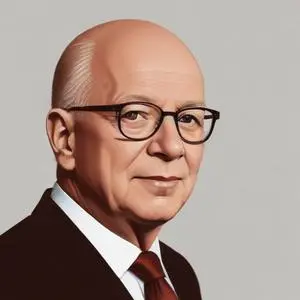
Founded the World Economic Forum, a prestigious annual gathering of global leaders to discuss and shape the world's economic agenda. Known for bridging the gap between politics, business, and academia to address pressing global issues.
As the founder and chairman of the World Economic Forum (WEF), Klaus Schwab has been instrumental in shaping the global economic landscape for over five decades. Since its inception in 1971, the WEF has become a premier platform for world leaders, entrepreneurs, and innovators to converge and address pressing global issues.
Born on March 30, 1938, in Ravensburg, Germany, Klaus Schwab grew up in a family that valued education and hard work. His father, Eugen Wilhelm Schwab, was a director at Escher Wyss AG, an industrial company that collaborated with the Nazi regime during World War II. Schwab's Catholic upbringing and Swiss-German heritage instilled in him a strong sense of responsibility and international perspective.
After completing his secondary education in Ravensburg, Schwab pursued a degree in mechanical engineering from the Swiss Federal Institute of Technology in Zurich. He later earned a doctorate in engineering and a master's degree in public administration from Harvard University's John F. Kennedy School of Government. Schwab's academic excellence and entrepreneurial spirit earned him a mentor in Henry Kissinger, the future National Security Advisor and Secretary of State.
Schwab's leadership philosophy emphasizes the importance of public-private partnerships, sustainable development, and stakeholder capitalism. He believes that businesses have a responsibility to create value not only for shareholders but also for society and the environment.
Through the WEF, Schwab has championed the causes of climate action, social entrepreneurship, and global cooperation. He has also pushed for greater diversity, equity, and inclusion in business and public policy.
Klaus Schwab's influence extends far beyond the WEF's annual gathering in Davos. He has inspired a generation of leaders to adopt sustainable and socially responsible practices.
Under Schwab's guidance, the WEF has launched several initiatives, including the Global Shapers Community, the Young Global Leaders program, and the Schwab Foundation for Social Entrepreneurship. These efforts have fostered a culture of collaboration and innovation, addressing pressing global challenges such as climate change, poverty, and inequality.
"TheFourth Industrial Revolution will be characterized by a range of new technologies that will combine the physical, digital and biological worlds."
"We must have a sense of urgency, because the window of opportunity is still open, but it is closing fast."
Klaus Schwab's legacy will be remembered as a beacon of hope for a more equitable, sustainable, and interconnected world. As the WEF looks to the future, Schwab's vision will continue to inspire and guide the next generation of leaders.
In a world marked by complexity, uncertainty, and division, Schwab's leadership has shown that collaboration, dialogue, and collective action can create a better future for all.
72 Years Old
The first female Chancellor of Germany, serving for 16 years, known for her leadership during the European sovereign-debt crisis and her role in shaping the European Union's policy. She's a highly influential figure in modern politics.
70 Years Old
A highly influential leader in global economics, serving as the head of the International Monetary Fund, shaping international monetary policies and promoting global financial stability. Known for her strong leadership and vision for a more equitable economic future.
96 Years Old
A billionaire investor and philanthropist who made a fortune through savvy market trades and now uses his wealth to support progressive causes and democratic ideals. Known for his generous donations to liberal politicians and social justice organizations.
80 Years Old
The 42nd President of the United States, a charismatic leader who reformed healthcare and economy, and infamous for his scandals.
73 Years Old
The former Prime Minister of the United Kingdom who led the country through a transformative period, including the Iraq War, and is known for his charismatic leadership and controversial decisions.
66 Years Old
Lead vocalist of U2, renowned for powerful voice and activism on global issues like poverty and AIDS, inspiring millions through music and humanitarian work.
78 Years Old
The 45th Vice President of the United States and Nobel Prize laureate is a prominent advocate for environmental protection, particularly climate change awareness, and has produced influential documentaries on the subject.
Born in 1918
A South African lawyer and politician who fought against apartheid, becoming the country's first black president and a symbol of racial reconciliation, earning a Nobel Peace Prize. He's a beacon of hope and freedom.
