


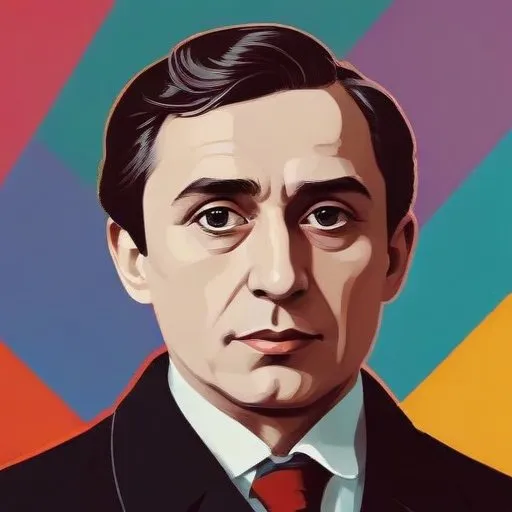
A celebrated Russian poet and author, known for his vivid descriptions of nature and poignant portrayals of Soviet life, exploring the human condition through lyrical prose.
Konstantin Paustovsky, a Soviet writer nominated for the Nobel Prize in Literature in 1965, is renowned for his poignant and introspective works that delve into the complexities of human relationships, love, and the search for meaning.
Born on May 31, 1892, in Moscow, Paustovsky's life was marked by upheaval and uncertainty. His father, a railroad statistician, was an incurable romantic and Protestant, while his mother came from a family of Polish intelligentsia. This eclectic mix of cultural influences would later shape Paustovsky's unique perspective on the world.
Paustovsky's family was of Zaporozhian Cossack, Turkish, and Polish origin, and he grew up partly in the countryside and partly in Kiev. He studied in the First Imperial classical Gymnasium of Kiev, where he was classmates with the future celebrated writer Mikhail Bulgakov.
After his father abandoned the family, Paustovsky was forced to give private lessons to earn a living. He later entered the faculty of Natural History at the University of Kiev, but World War I interrupted his education.
During the war, Paustovsky worked as a trolleyman in Moscow, then as a paramedic in a hospital train. He witnessed the horrors of war firsthand, and his experiences would later inform his writing.
In 1916, Paustovsky lived in Taganrog, where he worked at the Taganrog Boiler Factory. It was during this time that he started writing his first novel, Romantiki (Romantics), which was published in 1935.
This novel, whose title reflects its themes of youthful idealism and romanticism, described Paustovsky's own experiences and emotions during his youth. One of the heroes, the old Oscar, was an artist who resisted the pressures of becoming a moneymaker – a theme that would recur throughout Paustovsky's oeuvre.
Paustovsky's writing career spanned over four decades, during which he published numerous novels, short stories, and essays. His works are characterized by their lyricism, nuanced characterization, and profound exploration of the human condition.
Some of his notable works include The Black Gulf, The Golden Rose, and Kashchei the Immortal. These works showcase Paustovsky's mastery of language, his ability to evoke the beauty of the natural world, and his deep empathy for his characters.
Konstantin Paustovsky's contributions to Russian literature are immeasurable. He was a chronicler of the human experience, a writer who probed the depths of the human heart and soul.
Through his writing, Paustovsky has inspired generations of readers and writers alike. His legacy continues to resonate today, a testament to the power of literature to transcend time and borders.
Konstantin Paustovsky's life was a testament to the power of art to transcend adversity. Through his writing, he has left us a legacy that continues to inspire and enrich our understanding of the human experience.
Born in 1890
A Russian literary giant, renowned for his poetic and novelistic masterpieces, including the epic "Doctor Zhivago", which captured the essence of Soviet Russia. His works are a testament to the power of literature in shaping cultural identity.
Born in 1880
A Russian literary giant, known for pioneering the avant-garde movement in literature, blending poetry and prose to create innovative, symbolic works that explored the human experience.
Born in 1893
A Russian avant-garde artist who revolutionized poetry and theater with his bold, futuristic style and passionate performances. He's most famous for his vibrant, propaganda-inspired posters and poems that captured the spirit of the Russian Revolution.
Born in 1892
A Russian poet and author who poured her heart into lyrical verses, exploring themes of love, nature, and the human condition. Her works are a testament to her intense emotional depth and poetic genius.
Born in 1889
A renowned poet and literary icon of the Soviet era, celebrated for her poignant and evocative works that captured the essence of love, loss, and resilience amidst war and oppression.
Born in 1895
A renowned Russian poet, known for his lyrical and patriotic works that often romanticized rural Russia, and his tumultuous life that ended in tragedy at a young age.
Born in 1899
A Russian-born novelist and critic, renowned for crafting intricate, lyrical prose and exploring themes of identity, morality, and the human condition through works like "Lolita" and "Pale Fire".
