


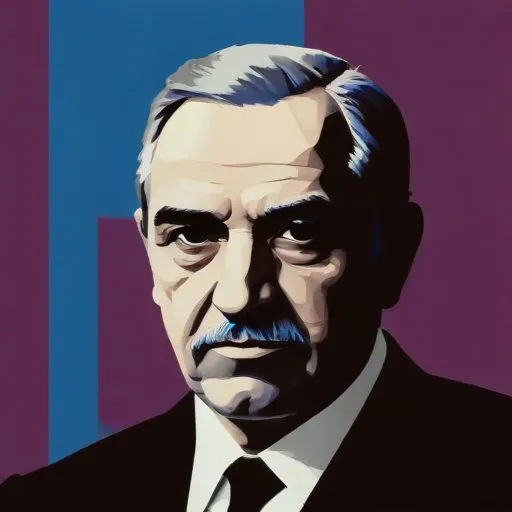
A renowned Greek scholar and politician who served as President of Greece, known for his significant contributions to the country's cultural and political development. He played a crucial role in shaping Greece's modern identity.
Konstantinos Tsatsos was a renowned Greek diplomat, professor of law, and politician, best known for serving as the second President of the Third Hellenic Republic from 1975 to 1980. Throughout his illustrious career, he made significant contributions to Greek politics, education, and law, earning him a lasting legacy in Greek history.
Born on July 1, 1899, in Athens, Greece, Tsatsos pursued his higher education at the Law School of the National and Kapodistrian University of Athens, graduating in 1918. He furthered his studies at the University of Heidelberg in Germany, earning his doctoral degree between 1924 and 1928.
After completing his doctoral studies, Tsatsos returned to Greece and became a professor of law at the National and Kapodistrian University of Athens in 1933. His academic endeavors were interrupted in 1940 when he was arrested and exiled for opposing the 4th of August Regime under Prime Minister Ioannis Metaxas. During World War II, he participated in the Greek Resistance and later fled to the Middle East, where the exiled Greek government was seated.
After the end of World War II, Tsatsos returned to Greece and entered politics, serving as Interior Minister in the first cabinet of Vice Admiral Petros Voulgaris from 1945 to 1946. He resigned from his academic post at the National and Kapodistrian University of Athens to focus on his political career, joining the Liberal Party in 1946. Later, he became a member of the National Radical Union, founded by Constantine Karamanlis in 1955, and served as Minister of Public Administration from 1955 to 1963.
In 1975, Tsatsos was elected as the President of the Republic, a position he held until 1980. During his presidency, he played a crucial role in consolidating democracy in Greece after the Metapolitefsi in 1974. After completing his presidential term, he continued to be involved in politics, serving as a member of the Hellenic Parliament and Minister for Culture.
Konstantinos Tsatsos left an indelible mark on Greek politics, education, and law. His contributions to the country's democratic consolidation, his dedication to education, and his commitment to public service have made him a revered figure in Greek history. His legacy serves as a testament to the power of dedication, hard work, and commitment to public service.
Born in 1907
A Greek lawyer and politician who served as President of Greece, known for leading the country's transition from military dictatorship to democracy. He's credited with modernizing Greece and joining the European Union.
Born in 1888
A Greek lawyer, economist, and politician who served as the Prime Minister of Greece from 2009 to 2011, known for his efforts to address the country's debt crisis.
Born in 1919
Greek economist and politician who served as Prime Minister of Greece, known for his socialist policies and efforts to reduce Greece's reliance on foreign capital. He also played a key role in Greece's accession to the European Union.
Born in 1864
A Greek statesman who played a crucial role in shaping modern Greece, leading the country through significant reforms and transformations. He's known for his visionary leadership and diplomatic prowess.
Born in 1883
A Greek general and politician who served as Prime Minister of Greece, known for his efforts to stabilize the country during a time of political turmoil. He played a key role in shaping Greece's post-war government.
Born in 1867
A Greek lawyer and politician who served as the 94th Prime Minister of Greece, known for his brief but tumultuous tenure marked by controversy and scandal.
Born in 1871
A Greek general and politician who served as the 130th Prime Minister of Greece, known for his authoritarian regime and opposition to the Axis powers during World War II. He implemented a series of reforms and modernization projects, but also suppressed political opposition and civil liberties.
