


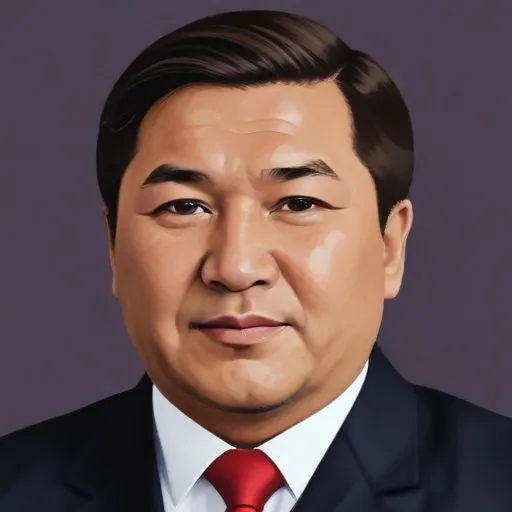
The second President of Kyrgyzstan, who ruled from 2005 to 2010 and was ousted in a bloody revolution, is most known for his corrupt and authoritarian regime. He was accused of embezzling millions of dollars and suppressing opposition.
Kurmanbek Saliyevich Bakiyev, born on August 1, 1949, is a Kyrgyz politician who served as the second president of Kyrgyzstan from 2005 to 2010. He is known for his tumultuous presidency, marked by corruption, nepotism, and human rights abuses, which ultimately led to his ousting in 2010.
Bakiyev was born in the village of Masadan in the Jalal-Abad Region of the Kirghiz SSR. His father, Sali Bakiyev, was the chairman of a collective farm. After graduating from the Kuibyshev Polytechnic Institute (now Samara State Technical University) in 1978, Bakiyev worked at a plugin connectors factory in Jalal-Abad from 1979 to 1985.
Bakiyev's political career began in 1990, when he became the first secretary of the Kok-Yangak City Committee of the Communist Party of Kirghizia. He later served as the Governor of the Jalal-Abad Region from 1995 to 1997 and the Governor of the Chui Region from 1997 to 2000. In December 2000, Bakiyev was appointed prime minister of Kyrgyzstan.
Following the Tulip Revolution in 2005, which ousted President Askar Akayev, Bakiyev won the presidential election with 89% of the vote. He was inaugurated as president on August 14, 2005, and initially enjoyed strong popular support, particularly from the southern regions of the country.
However, Bakiyev's presidency was marked by numerous controversies, including corruption, nepotism, and human rights abuses. He was accused of concentrating power in his family's hands, with several relatives holding key government positions. The country's economy suffered during his presidency, and he was criticized for his handling of prison riots and the murder of several prominent politicians.
In 2007, Bakiyev initiated the creation of the Ak Jol party, but could not lead it due to his presidency. The party went on to become a dominant force in Kyrgyz politics, but its connection to Bakiyev's family and corrupt practices raised concerns about the country's democratic trajectory.
In April 2010, large-scale protests broke out across the country, calling for Bakiyev's resignation. The protests turned violent, and government offices were taken over by opposition forces. Bakiyev was forced to flee the country, eventually seeking asylum in Belarus.
Kurmanbek Bakiyev's presidency had a lasting impact on Kyrgyzstan's political landscape. While he initially brought stability to the country after the Tulip Revolution, his corrupt and authoritarian practices ultimately led to his downfall. His legacy serves as a cautionary tale about the dangers of unchecked power and the importance of democratic accountability.
Despite his controversial legacy, Kurmanbek Bakiyev remains a significant figure in Kyrgyz politics, with his family still wielding considerable influence in the country. His story serves as a reminder of the importance of democratic accountability and the need for strong institutions to prevent the concentration of power.
81 Years Old
First President of Kyrgyzstan, leading the country to independence from the Soviet Union and implementing economic reforms. Known for his efforts to establish a democratic government in the newly independent nation.
69 Years Old
The 4th President of Kyrgyzstan, serving from 2011 to 2017, known for his efforts to strengthen the country's economy and democratic institutions. He also played a key role in transitioning power peacefully.
85 Years Old
First President of Kazakhstan, leading the country to independence from the Soviet Union and shaping its modern identity. He's credited with maintaining stability and economic growth during his long tenure.
88 Years Old
First President of Uzbekistan, ruling from 1991 until his death in 2016, known for his authoritarian regime and human rights abuses. He maintained a tight grip on power and suppressed opposition.
68 Years Old
Turkmenistan's authoritarian leader, known for his eccentric personality, grandiose projects, and human rights abuses, ruled the country with an iron fist from 2006 to 2022.
