


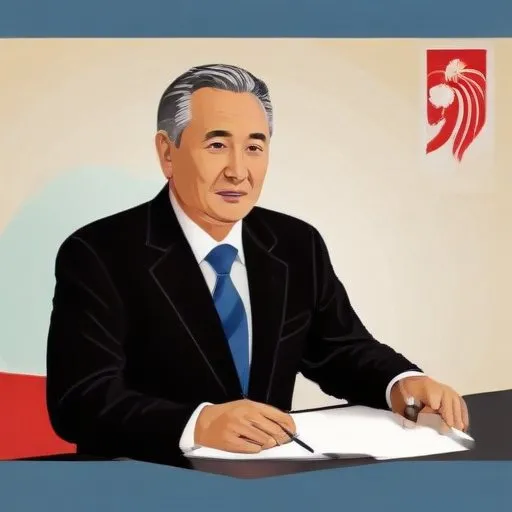
First President of Kyrgyzstan, leading the country to independence from the Soviet Union and implementing economic reforms. Known for his efforts to establish a democratic government in the newly independent nation.
Askar Akayev, born on November 10, 1944, is a Kyrgyz politician who served as President of Kyrgyzstan from 1990 until his ousting in the 2005 Tulip Revolution. He is known for being the country's first elected president, marking a significant transition from Soviet rule to independence.
Akayev's humble beginnings were rooted in Kyzyl-Bayrak, Kirghiz Soviet Socialist Republic, where he was the eldest of five sons born to collective farm workers. He began his career as a metalworker at a local factory in 1961, but his academic pursuits would soon take him to Leningrad, where he trained as a physicist.
Graduating from the Leningrad Institute of Precision Mechanics and Optics in 1967 with honors in mathematics, engineering, and computer science, Akayev stayed on as a senior researcher and teacher until 1976. It was during this period that he met and married Mayram Akayeva, with whom he would have two sons and two daughters.
Returning to his native Kyrgyzstan in 1977, Akayev became a senior professor at the Frunze Polytechnic Institute, where some of his later cabinet members were former students and friends. He obtained a doctorate in 1981 from the Moscow Institute of Engineering and Physics, with a dissertation on holographic systems of storage and transformation of information.
In 1984, Akayev became a member of the Kyrgyz Academy of Sciences, rising to vice president in 1987 and eventually president of the academy in 1989. He was also elected as a deputy in the Supreme Soviet of the USSR in the same year, setting the stage for his eventual presidency.
On October 25, 1990, the Kyrgyz SSR's Supreme Soviet held elections for the newly created post of president of the republic. Akayev emerged victorious, marking the beginning of his tumultuous tenure as president.
Akayev's presidency was marked by a delicate balancing act between maintaining relations with Russia and pursuing Kyrgyzstan's independence. His rule was also marred by allegations of nepotism, corruption, and authoritarianism, which ultimately led to his downfall in the 2005 Tulip Revolution.
Despite his controversies, Akayev's legacy as Kyrgyzstan's first elected president cannot be overstated. He played a crucial role in navigating the country's transition from Soviet rule to independence, and his academic background brought a level of intellectual sophistication to the presidency.
After his ousting, Akayev fled to Russia, where he has lived in exile since 2005. Despite his tumultuous past, he remains a significant figure in Kyrgyzstan's history, with his life serving as a testament to the complexities of Central Asian politics.
"The XXI century will be the century of knowledge, and education will play a crucial role in shaping the future of our country."
"Kyrgyzstan's independence is not a gift from anyone, it is a result of our people's struggle and sacrifice."
Akayev's legacy extends beyond Kyrgyzstan's borders, with his presidency serving as a model for other Central Asian countries transitioning from Soviet rule to independence. His emphasis on education and intellectual development also left a lasting impact on the country's academic community.
In conclusion, Askar Akayev's life is a testament to the complexities of politics, academia, and leadership. While controversies surrounded his presidency, his contributions to Kyrgyzstan's independence and intellectual development cannot be overstated.
86 Years Old
First President of Kazakhstan, leading the country to independence from the Soviet Union and shaping its modern identity. He's credited with maintaining stability and economic growth during his long tenure.
88 Years Old
First President of Uzbekistan, ruling from 1991 until his death in 2016, known for his authoritarian regime and human rights abuses. He maintained a tight grip on power and suppressed opposition.
69 Years Old
Turkmenistan's authoritarian leader, known for his eccentric personality, grandiose projects, and human rights abuses, ruled the country with an iron fist from 2006 to 2022.
86 Years Old
The authoritarian leader who ruled Turkmenistan with an iron fist, imposing a cult of personality and eccentric policies, while exploiting the country's natural resources for personal gain.
Born in 1923
Azerbaijan's leader who ruled with an iron fist, modernizing the country while suppressing opposition, leaving a lasting legacy in the region.
Born in 1923
Azerbaijan's leader who ruled with an iron fist, modernizing the country while suppressing opposition, leaving a lasting legacy in the region.
