


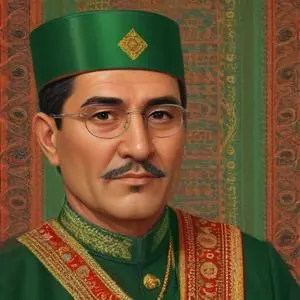
The authoritarian leader who ruled Turkmenistan with an iron fist, imposing a cult of personality and eccentric policies, while exploiting the country's natural resources for personal gain.
Saparmurat Niyazov, also known as Turkmenbashi, was a Turkmen politician who ruled Turkmenistan with an iron fist from 1985 until his death in 2006. He is infamous for his totalitarian regime, cult of personality, and eccentric policies that shaped the country in his image.
Niyazov's rise to power began in 1985, when he became the First Secretary of the Communist Party of Turkmenistan. He supported the 1991 Soviet coup attempt, but after its failure, he declared Turkmenistan's independence from the Soviet Union in 1991. He then ruled the country as president for 15 years, solidifying his grip on power and crushing any opposition.
Niyazov's regime was marked by an extreme cult of personality. He was referred to as "His Excellency Saparmurat Turkmenbashi, President of Turkmenistan and Chairman of the Cabinet of Ministers." He promoted himself as the "Head of the Turkmen" and the founder and president of the Association of Turkmens of the World. In 1999, the Assembly of Turkmenistan declared him president for life.
Niyazov's most enduring legacy is the Ruhnama, his autobiography, which he claimed was a spiritual guide for the Turkmen people. He made it mandatory to read the Ruhnama in schools, universities, and governmental organizations. New governmental employees were tested on the book at job interviews, and an exam on its teachings was a part of the driving test in Turkmenistan.
Niyazov's regime was marked by a series of eccentric policies. He renamed the months of the year and days of the week to references from his autobiography. He also closed down all rural libraries and hospitals outside of the capital city Ashgabat, citing that "if people are ill, they can come to Ashgabat."
Niyazov's regime was notorious for its human rights abuses and repression. Under his rule, Turkmenistan had the lowest life expectancy in Central Asia. Global Witness, a London-based human rights organization, reported that money under Niyazov's control and held overseas may be in excess of US$3 billion, of which between $1.8-2.6 billion was allegedly siphoned off for personal use.
Saparmurat Niyazov's legacy is a complex one. While he is remembered as a ruthless dictator who crushed opposition and promoted a cult of personality, he also oversaw significant economic growth and invested heavily in infrastructure development. Despite his flaws, Niyazov remains a fascinating figure, whose life and rule continue to captivate historians and political analysts.
"If people are ill, they can come to Ashgabat." - Saparmurat Niyazov
"The Ruhnama is a spiritual guide for the Turkmen people." - Saparmurat Niyazov
Born in 1904
A Chinese revolutionary and statesman who led the country's economic reforms, transforming it into a global superpower. He's credited with opening up China to the world and introducing capitalist principles.
Born in 1893
Leader of the Chinese Communist Party who implemented radical social and economic reforms, including the Great Leap Forward and the Cultural Revolution, shaping modern China's politics and economy.
Born in 1878
The Soviet Union's ruthless leader who ruled with an iron fist, implementing policies that led to widespread famine and purges, while also playing a crucial role in defeating Nazi Germany in World War II.
Born in 1870
Founder of the world's first socialist state, leading the Bolshevik Revolution and establishing the Soviet Union, known for his radical Marxist ideology and authoritarian rule.
Born in 1906
A Soviet leader who ruled with an iron fist, implementing policies that stagnated the economy and suppressed dissent, while also being a key figure in the Cold War. He's infamous for his authoritarian regime and bureaucratic inefficiency.
Born in 1894
The Soviet leader who initiated reforms and denounced Stalin's regime, known for his bold policies and iconic shoe-banging incident at the UN.
95 Years Old
The last leader of the Soviet Union, who introduced reforms that led to the end of the Cold War and the collapse of communism, earning a Nobel Peace Prize. He's known for his policies of glasnost and perestroika, which transformed the Soviet Union and the world.
95 Years Old
First President of Russia, leading the country's transition from communism to democracy, and known for his bold reforms and iconic leadership style.
