


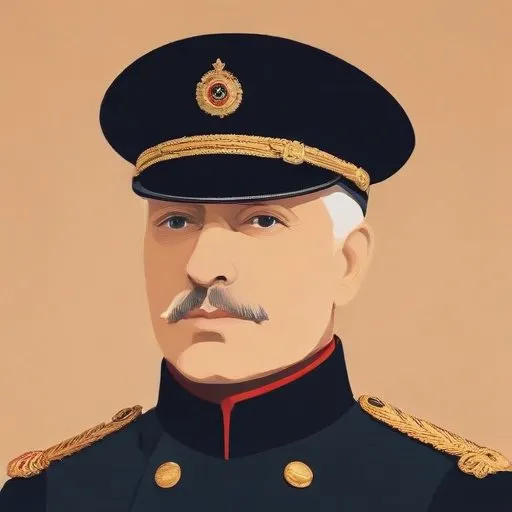
A renowned Prussian military leader who played a crucial role in the Seven Years' War, earning recognition for his bravery and tactical genius. He's celebrated for his victories against the Austrians and Russians, showcasing exceptional military prowess.
Kurt Christoph Graf von Schwerin was a renowned Prussian Generalfeldmarschall, one of the most skilled and influential commanders under Frederick the Great. He is best known for his exceptional military leadership, particularly during the First Silesian War, where he secured a crucial victory at the Battle of Mollwitz in 1741.
Born on October 26, 1684, in Löwitz, Swedish Pomerania, Schwerin entered the Dutch army at a young age and served in various battles, including Schellenberg and Blenheim. He later joined the army of the Duke of Mecklenburg-Schwerin, where he fought in several engagements, including Ramillies and Malplaquet.
In 1713, Schwerin was present during Charles XII of Sweden's captivity at Bender. He later became a major general in 1718 and opposed the Hanoverian Army during their invasion of Mecklenburg in 1719. His bravery and tactical genius earned him recognition, and he was appointed as a member of the court martial that tried the crown prince Frederick for desertion in 1730.
Schwerin's most notable achievement was his victory at the Battle of Mollwitz in 1741, which decided the fate of Silesia. He successfully persuaded King Frederick the Great to leave the battlefield, and his leadership converted a doubtful battle into a decisive victory. This triumph solidified Schwerin's position as one of the most trusted and respected commanders in the Prussian army.
After the war, Schwerin was appointed governor of the important fortresses of Brieg and Neisse. He continued to serve the Prussian army with distinction, earning the rank of general field marshal and being elevated to the title of count.
Schwerin's personal life remains somewhat shrouded in mystery, but it is known that he was deeply respected by King Frederick the Great, who valued his counsel and military expertise. Schwerin's relationships with his contemporaries were marked by professionalism and a strong sense of duty.
Schwerin's military legacy has had a lasting impact on modern society. His innovative tactics and leadership during the Battle of Mollwitz paved the way for future military strategists and commanders. His influence can be seen in the development of modern military tactics and the importance of adaptability on the battlefield.
Kurt Christoph Graf von Schwerin's remarkable military career and achievements continue to inspire and educate military historians and strategists to this day. His legacy serves as a testament to the importance of strong leadership, tactical genius, and bravery in the face of adversity.
Born in 1712
Prussian king who ruled with Enlightenment values, promoting arts, education, and religious tolerance, while also being a skilled military strategist and expanding his kingdom through wars.
Born in 1755
A pioneering military reformer who modernized the Prussian army and played a key role in the Napoleonic Wars, known for his innovative tactics and strategic thinking.
Born in 1760
A highly influential Prussian military strategist who reformed the Prussian army and played a key role in defeating Napoleon, earning him a legendary status in military history.
