


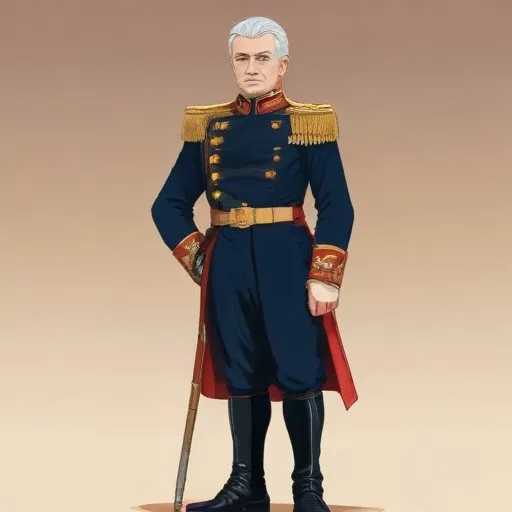
A pioneering military reformer who modernized the Prussian army and played a key role in the Napoleonic Wars, known for his innovative tactics and strategic thinking.
Gerhard von Scharnhorst was a Hanoverian-born general in Prussian service, renowned for his groundbreaking military theories, reforms of the Prussian army, and exceptional leadership during the Napoleonic Wars. As the first Chief of the Prussian General Staff, Scharnhorst introduced radical changes that transformed the military landscape, earning him a reputation as one of the most influential military minds in history.
Born on November 12, 1755, at Bordenau, near Hanover, into a minor landowning family, Scharnhorst was driven to educate himself and secure a place in the military academy of William, Count of Schaumburg-Lippe, at the Wilhelmstein fortress. He received a commission into the Hanoverian service in 1778 and employed his spare time to further his self-education and literary pursuits.
Scharnhorst's transfer to the artillery in 1783 marked the beginning of his ascent in the military hierarchy. He established a military journal, which he published under various names until 1805, and wrote the seminal Handbook for Officers in the Applied Sections of Military Science in 1788. This comprehensive guide showcased his innovative approach to military strategy and tactics. In 1792, he published the Military Handbook for Use in the Field, cementing his reputation as a leading military theorist.
Scharnhorst's reforms aimed to modernize the Prussian army, focusing on merit-based promotion, reduction of corporal punishments, and the abolition of foreign recruitment. He also established a reserve army and streamlined military administration, laying the groundwork for a more efficient and effective fighting force.
Scharnhorst's military prowess was evident during the Napoleonic Wars, where he played a crucial role in shaping Prussia's military strategy. His leadership and vision inspired a generation of military leaders, including Carl von Clausewitz, who later built upon Scharnhorst's ideas.
Scharnhorst's legacy extends beyond his military accomplishments. He was a prolific writer andeducationalist, and his works continue to influence military thought and strategy. His commitment to meritocracy and reduction of corporal punishment paved the way for more humane and modern military practices.
Scharnhorst married Clara Schmalz, sister of Theodor Schmalz, the first director of Berlin University, and had a family to support. Despite his modest background, he remained dedicated to his craft, relying on his writings to supplement his income.
Scharnhorst's first military campaign in 1793 in the Netherlands, where he served under the Duke of York, marked the beginning of his distinguished military career. He later took part in the defence of Menen in 1794, further solidifying his reputation as a skilled military leader.
Scharnhorst's reforms and ideas have had a lasting impact on modern warfare. His emphasis on merit-based promotion, military education, and the importance of a reserve army continue to shape military doctrine. His commitment to reducing corporal punishment paved the way for more humane military practices.
A true pioneer in military thought, Scharnhorst's legacy continues to inspire military leaders, historians, and scholars alike. His groundbreaking ideas and reforms have left an indelible mark on the history of warfare, cementing his place as one of the most influential military minds in history.
Gerhard von Scharnhorst's revolutionary ideas and reforms have left a lasting impact on modern warfare, making him an indispensable figure in military history.
Born in 1865
A German general and politician who played a crucial role in World War I, masterminding the 1918 Spring Offensive and later promoting Nazi ideology.
Born in 1847
A German field marshal and politician who served as the 2nd President of Germany during the Weimar Republic, playing a crucial role in the rise of the Nazi Party. He's infamous for appointing Adolf Hitler as Chancellor of Germany in 1933.
Born in 1851
A French field marshal who played a crucial role in World War I, leading the Allied forces to victory and earning the title "The Tiger" for his tenacity and strategic genius. He's also known for his post-war efforts to maintain peace and stability in Europe.
