


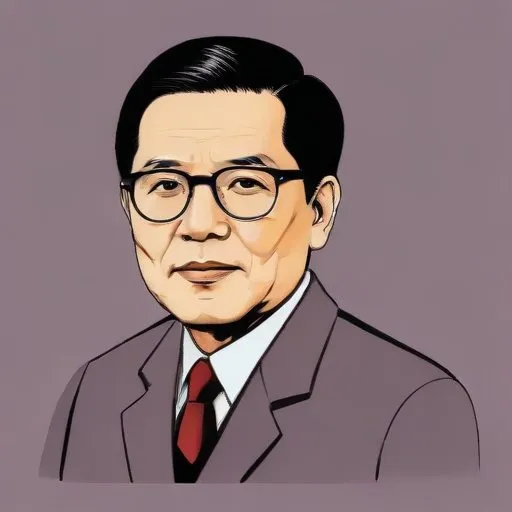
The fourth President of the Republic of China, a key figure in Taiwan's transition to democracy, known for his bold economic reforms and advocacy for Taiwanese identity. He played a crucial role in shaping Taiwan's modern politics and economy.
Revered as "Mr. Democracy," Lee Tenghui is the Taiwan-born statesman who spearheaded the island's transition to democracy, ending decades of martial law and authoritarian rule. As the fourth President of the Republic of China (Taiwan) and Chairman of the Kuomintang (KMT) from 1988 to 2000, Lee's visionary leadership transformed Taiwan's political landscape, earning him a permanent place in history.
Born on January 15, 1923, in the rural farming community of Sanshi Village, Taihoku Prefecture, Japanese Taiwan, Lee's early years were marked by a fascination with the world beyond his small village. An avid stamp collector, he dreamed of traveling abroad, an ambition that would later shape his foreign policy agenda. His exposure to Japanese colonial rule instilled in him a strong interest in Japan, which he would later leverage to Taiwan's advantage.
After graduating from Taihoku Higher School, one of the only four Taiwanese students in his class, Lee's academic prowess earned him a scholarship to Kyoto University, where he studied agricultural economics. His intellectual curiosity and leadership skills soon drew attention, and in 1978, he was appointed Minister of Agriculture, marking the beginning of his illustrious political career.
As President, Lee oversaw the end of martial law in 1987, paving the way for democratic reforms. He championed the Taiwanese localization movement, promoting Taiwan's unique identity and advocating for its recognition on the global stage. His ambitious foreign policy agenda aimed to strengthen Taiwan's diplomatic ties, earning him the reputation of a master diplomat.
Lee's presidency (1988-2000) is often referred to as the "Golden Era" of Taiwanese politics. His commitment to democracy, human rights, and Taiwan's sovereignty helped transform the island into a beacon of hope for Asian democracies. After leaving office, he remained an influential figure, guiding the Taiwan Solidarity Union and promoting Taiwanese independence.
"Democracy is not just a matter of procedure; it's a way of life."
"Taiwan is a country, and its sovereignty belongs to the Taiwanese people."
Lee's life serves as a testament to the power of vision, perseverance, and leadership. His courage in the face of adversity and his unwavering commitment to democracy have inspired generations of Taiwanese and people worldwide. As the "Father of Taiwanese Democracy," Lee's legacy continues to shape Taiwan's destiny, reminding us that even the most ambitious dreams can become a reality with determination and hard work.
Born in 1887
Led the Nationalist Party in China, fighting against the Communist Party and later establishing the government of Taiwan. He's known for his role in shaping modern Chinese history.
Born in 1910
Third President of the Republic of China, leading Taiwan's transition from authoritarian rule to democracy, and implementing economic reforms. He's credited with ending martial law and introducing democratic elections.
76 Years Old
The 12th President of the Republic of China, a Hong Kong-Taiwanese commander and politician, is known for his efforts to improve relations with mainland China and his role in shaping Taiwan's economy. He's also recognized for his moderate stance on Taiwanese independence.
69 Years Old
The first female president of Taiwan, known for her efforts to strengthen the country's sovereignty and promote its international presence, while navigating complex relations with China.
89 Years Old
The first Taiwanese-born Vice President of the Republic of China, who played a key role in improving cross-strait relations with mainland China through diplomatic visits and negotiations. He's known for his efforts to ease tensions between the two nations.
84 Years Old
A Taiwanese politician who served as the Governor of Taiwan Province from 1994 to 1998 and founded the People First Party in 2000. He's known for his efforts to promote Taiwanese identity and cross-strait relations.
