


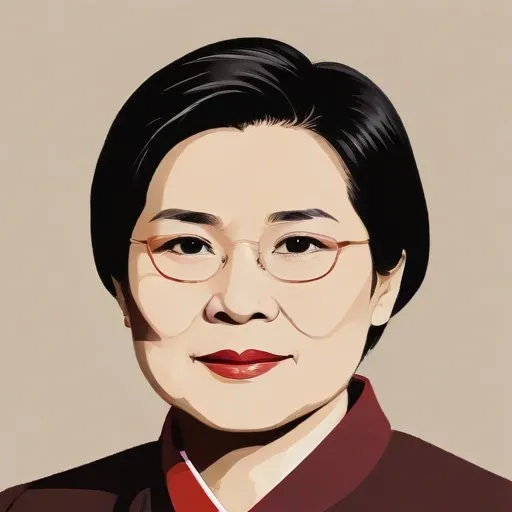
The first Taiwanese-born Vice President of the Republic of China, who played a key role in improving cross-strait relations with mainland China through diplomatic visits and negotiations. He's known for his efforts to ease tensions between the two nations.
Lien Chan, a Taiwanese politician, is renowned for his groundbreaking visit to Mainland China in 2005, marking the first meeting between the leaders of the Kuomintang (KMT) and the Chinese Communist Party (CCP) since the end of the Chinese Civil War in 1949. This historic encounter significantly thawed the long-stalled cross-strait relations, earning him widespread recognition and respect.
Lien Chan was born on August 27, 1936, in Xi'an, Shaanxi province, China, to a Taiwanese father, Lien Chentung, and a Mainland Chinese mother, Chao Lankun. His paternal grandfather, Lien Heng, was a prominent writer, best known for his book, "The General History of Taiwan."
Lien Chan earned a Bachelor's degree in Political Science from National Taiwan University in 1957 and a Master's degree in International Law and Diplomacy in 1961. He went on to receive his PhD in International Law and Diplomacy, solidifying his foundation in politics and international relations.
Lien Chan's political career spanned over three decades, during which he held various prominent positions. He served as the Chairman of the Taiwan Provincial Government from 1990 to 1993, Premier of the Republic of China from 1993 to 1997, and Vice President of the Republic of China from 1996 to 2000.
He was the Chairman of the Kuomintang (KMT) from 2000 to 2005, apart from various ministerial posts he held. Lien Chan ran for the President of the Republic of China on behalf of the KMT in 2000 and 2004, although he lost both times to Chen Shui-bian of the Democratic Progressive Party.
In 2005, Lien Chan made a historic visit to Mainland China, meeting with the General Secretary of the Chinese Communist Party, Hu Jintao, on April 29, 2005. This meeting marked a significant milestone in cross-strait relations, as it was the first encounter between the leaders of the KMT and the CCP since the end of the Chinese Civil War in 1949.
This groundbreaking visit helped to ease tensions and paved the way for improved relations between Taiwan and Mainland China. Lien Chan's efforts were widely recognized, earning him the title of Honorary Chairman of the KMT upon his retirement in August 2005.
Lien Chan's contributions to Taiwanese politics and cross-strait relations are undeniable. His commitment to improving relations between Taiwan and Mainland China has had a lasting impact on the region. As a statesman, he has demonstrated exceptional leadership, vision, and diplomacy, earning him a revered place in Taiwanese history.
Lien Chan is married to Fang Yu, and they have two children together, Lien Hui-yi and Lien Huan-yi. His personal life is marked by a strong sense of family and a deep commitment to his country, Taiwan.
Lien Chan's approach to politics has been guided by his strong belief in the importance of dialogue and cooperation. He has consistently advocated for improved relations between Taiwan and Mainland China, demonstrating his commitment to peaceful and constructive engagement.
Lien Chan has received numerous awards and honors for his contributions to Taiwanese politics and cross-strait relations, including the title of Honorary Chairman of the KMT. His achievements continue to inspire generations of Taiwanese politicians and leaders.
Lien Chan's legacy extends beyond the realm of politics, as his efforts have had a profound impact on modern society. His commitment to improving cross-strait relations has paved the way for increased economic cooperation, cultural exchange, and people-to-people diplomacy between Taiwan and Mainland China.
Today, Lien Chan's contributions serve as a testament to the power of diplomacy and cooperation, inspiring future generations to strive for peaceful and constructive engagement in the pursuit of common goals and prosperity.
Born in 1887
Led the Nationalist Party in China, fighting against the Communist Party and later establishing the government of Taiwan. He's known for his role in shaping modern Chinese history.
Born in 1910
Third President of the Republic of China, leading Taiwan's transition from authoritarian rule to democracy, and implementing economic reforms. He's credited with ending martial law and introducing democratic elections.
Born in 1923
The fourth President of the Republic of China, a key figure in Taiwan's transition to democracy, known for his bold economic reforms and advocacy for Taiwanese identity. He played a crucial role in shaping Taiwan's modern politics and economy.
75 Years Old
The 12th President of the Republic of China, a Hong Kong-Taiwanese commander and politician, is known for his efforts to improve relations with mainland China and his role in shaping Taiwan's economy. He's also recognized for his moderate stance on Taiwanese independence.
69 Years Old
The first female president of Taiwan, known for her efforts to strengthen the country's sovereignty and promote its international presence, while navigating complex relations with China.
85 Years Old
A Taiwanese politician who served as the President of the Legislative Yuan from 1999 to 2016, known for his efforts to promote cross-strait relations with China. He played a key role in shaping Taiwan's political landscape.
