


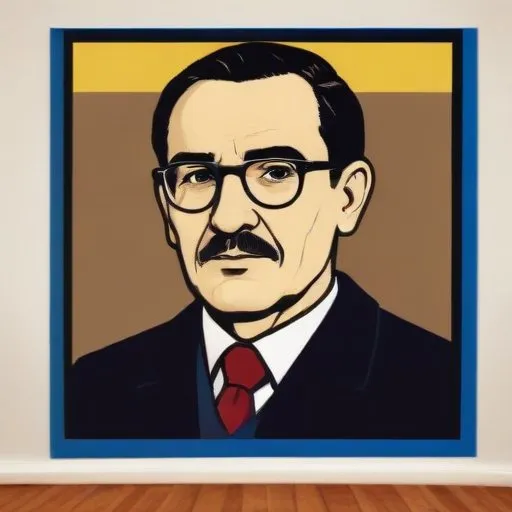
A renowned expert in Islamic art and archaeology, particularly famous for his groundbreaking research on Middle Eastern ceramics and numismatics.
Leo Aryeh Mayer, a luminary in the realm of Islamic art and archaeology, left an indelible mark on the academic community with his meticulous research and groundbreaking discoveries. As the first rector of the Hebrew University of Jerusalem, Mayer's unparalleled expertise in the field earned him widespread recognition, solidifying his position as a pioneer in his domain.
Born on January 12, 1895, in Stanisławów, Galicia (present-day Ivano-Frankivsk, Ukraine), Mayer hailed from an esteemed rabbinical Hasidic family. His fascination with Eastern Art led him to pursue higher education at the University of Vienna, where he specialized in the cultural history of the Muslim East. Mayer's academic pursuits also took him to the University of Lausanne and the University of Berlin, culminating in a doctorate from the University of Vienna in 1917 for his thesis on town planning in Islam.
During his time in Vienna, Mayer received training at the Jewish Theological Seminary and became an integral part of the Zionist Hashomer movement, later known as the Hashomer Hatzair. His early career witnessed him teaching and working as an assistant librarian at the Institute of Oriental Studies. In 1919, Mayer returned to his hometown and began teaching in high school, but the tumultuous post-World War I era prompted him to relocate to Berlin, where he joined the oriental department of the city's state library.
In 1921, Mayer emigrated to Mandate Palestine, marking a significant turning point in his career. He began working at the Department of Antiquities of the government of the British Mandate as an inspector, eventually rising to the position of Director of the Archives from 1929 to 1933. Mayer's expertise in Islamic art and archaeology led to his appointment as a supervisor at the new Government Museum in Jerusalem.
In 1925, Mayer joined the inaugural staff of the Institute of Jewish Studies at the Hebrew University of Jerusalem, where he was appointed Lecturer in Islamic Art and Archaeology in 1929. This marked the beginning of a fruitful association with the university, which would ultimately lead to his appointment as rector in later years.
Leo Aryeh Mayer's trailblazing work in Islamic art and archaeology has had a lasting impact on the academic community. His groundbreaking research, meticulous scholarship, and dedication to the field have inspired generations of scholars. As a testament to his contributions, Mayer's legacy continues to shape our understanding of Islamic cultural heritage.
Mayer's outstanding achievements were recognized with the honor of Officer of the Order of the British Empire (OBE) in 1945.
Leo Aryeh Mayer's remarkable life and career serve as a testament to his unwavering dedication to the pursuit of knowledge and his unrelenting passion for Islamic art and archaeology. His pioneering work continues to inspire generations of scholars, ensuring his legacy in the annals of academic history.
Born in 1907
A prominent Jewish scholar who merged traditional faith with modern philosophy, advocating for social justice and interfaith dialogue through his influential writings and activism.
Born in 1897
A renowned expert on Jewish mysticism and Kabbalah, uncovering the hidden symbolism and codes within ancient texts, and shedding light on the esoteric traditions of Judaism.
Born in 1878
A philosopher who explored the nature of human relationships, dialogue, and existence, and is best known for his concept of "I-Thou" relationships, which emphasizes mutual respect and understanding.
Born in 1906
A 20th-century philosopher and theorist who explored the nature of power, politics, and humanity, particularly in the context of totalitarianism and the Holocaust.
Born in 1903
A critical theorist who critiqued modern society, culture, and capitalism, arguing that they perpetuate inequality and stifle individual freedom. His work influenced many fields, from sociology to musicology.
Born in 1895
A critical theorist who developed the concept of Critical Theory, which critiques modern capitalist society and advocates for social change. Known for his work on authoritarianism and the culture industry.
Born in 1898
A critical theorist who challenged traditional notions of freedom, democracy, and consumerism, arguing that modern society is oppressive and dehumanizing.
Born in 1900
A German psychologist and sociologist who developed the concept of "social character" and explored the relationship between psychology and society, known for his humanistic and socialist approach.
