


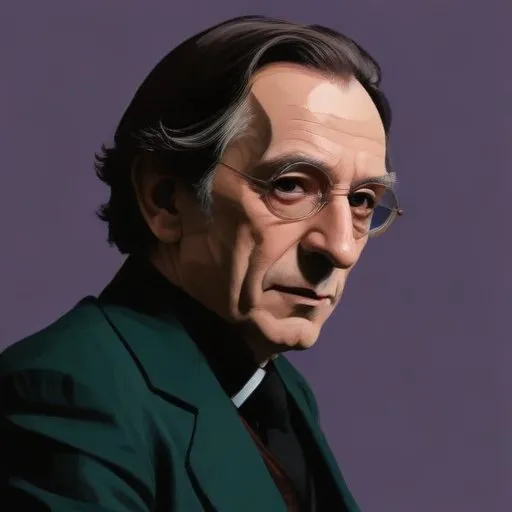
A renowned composer and educator, he crafted innovative, expressive works that blended traditional and modern elements, earning him a Pulitzer Prize and numerous accolades. His music continues to inspire and influence contemporary composers.
Leon Kirchner, the American composer of contemporary classical music, is renowned for his unique and innovative style that defied conventions. He is celebrated for his String Quartet No. 3, which earned him the prestigious Pulitzer Prize in 1967.
Born on January 24, 1919, in Brooklyn, New York, Kirchner began his music studies at the tender age of four. Five years later, his family moved to Los Angeles, where he continued his musical education. He started composing while attending Los Angeles City College, encouraged by his piano teachers and Ernst Toch.
With the support of Arnold Schoenberg, Kirchner entered the University of California, Los Angeles, where he further honed his skills. He later moved to the University of California, Berkeley, where he earned the George Ladd Prix de Paris in 1942. During World War II, Kirchner studied with Roger Sessions in New York, and after the war, he returned to Berkeley as a lecturer, assisting Sessions and Ernest Bloch in theory.
Kirchner's academic career spanned several prestigious institutions, including the University of Buffalo, the University of California, the University of Southern California, Yale University, the Juilliard School of Music, and Mills College, where he was the first Luther Brusie Marchant Professor from 1954 to 1961. In 1961, he joined Harvard University, succeeding Walter Piston as the Walter Bigelow Rosen Professor of Music, a position he held until 1989.
Throughout his academic career, Kirchner mentored numerous students who went on to become renowned composers, conductors, and musicians. His teaching philosophy emphasized the importance of individuality and creativity, and he was known for his ability to inspire and nurture talent.
Kirchner's compositional style was characterized by his unwavering commitment to individuality and artistic expression. He rejected the constraints of traditional forms and stylistic conventions, instead opting for a more avant-garde approach. According to Alexander Ringer, Kirchner remained "consistently individual, unimpressed by changing fashion, where idea, the precious ore of art, is lost in the jungle of graphs, prepared tapes, feedbacks, and cold stylistic minutiae."
Kirchner married Gertrude Schoenberg, a singer and student of Arnold Schoenberg, on July 8, 1949. They had one son and one daughter. He passed away on September 17, 2009, at the age of 90, due to congestive heart failure at his home on Central Park West in New York City.
Leon Kirchner's contributions to contemporary classical music are immeasurable. He paved the way for future generations of composers, inspiring them to experiment and push the boundaries of traditional forms. His Pulitzer Prize-winning String Quartet No. 3 remains a testament to his innovative spirit and artistic vision.
In his own words, Kirchner said, "I think the most important thing is to be true to oneself, to find one's own voice, and to have the courage to pursue it, even if it means going against the tide."
Leon Kirchner's life and work spanned a tumultuous period in American history, marked by World War II, the Cold War, and the emergence of new musical styles. His legacy serves as a testament to the power of individuality and creative expression in the face of adversity.
In the words of Alexander Ringer, Kirchner's music "remains a beacon of hope, a testament to the human spirit's capacity to create, to innovate, and to persevere."
Born in 1925
A renowned French musician who revolutionized classical music with his avant-garde compositions and innovative conducting style, pushing boundaries and redefining the genre.
Born in 1908
A pioneering composer of modern classical music, known for his complex and innovative works that pushed the boundaries of harmony and rhythm.
Born in 1923
A visionary composer and educator who pushed the boundaries of classical music with his avant-garde and innovative works, blending dissonance and harmony in unique ways.
98 Years Old
A pioneer of electronic and avant-garde music, this composer pushed boundaries with unconventional sounds and performances, influencing generations of musicians and artists.
Born in 1882
A Russian master of music, renowned for revolutionizing classical music with bold, avant-garde compositions that blended traditional and modern elements. His iconic works, such as "The Rite of Spring," continue to inspire and influence artists across genres.
Born in 1881
A Hungarian musical genius who merged folk melodies with modernist techniques, creating a unique sound that transformed classical music.
Born in 1874
A pioneer of atonality and 12-tone serialism, revolutionizing classical music with innovative compositions that pushed boundaries of harmony and melody.
92 Years Old
A controversial radio host and lawyer who sparked heated debates with his outspoken views, ultimately becoming a martyr for free speech after a tragic assassination.
