


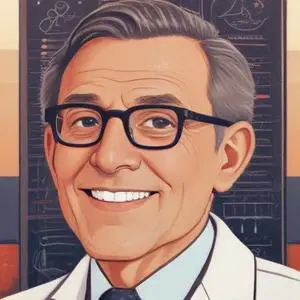
Pioneering immunologist and geneticist who developed the fluorescence-activated cell sorter (FACS), a groundbreaking tool for isolating and analyzing cells. His work revolutionized the field of immunology and led to numerous medical breakthroughs.
Leonard Herzenberg, a renowned immunologist and geneticist, revolutionized the field of cell biology with his groundbreaking contributions, making it possible to sort viable cells by their specific properties. His work on the fluorescence-activated cell sorter (FACS) and hybridoma technology has had a profound impact on immunology and cancer biology.
Leonard Arthur Herzenberg was born on November 5, 1931, in New York City. He pursued his undergraduate degree in biology and chemistry from Brooklyn College, graduating in 1952. Herzenberg then went on to earn his Ph.D. in biochemistry from the California Institute of Technology in 1955, specializing in immunology.
After completing his Ph.D., Herzenberg worked as a postdoctoral fellow at the American Cancer Society and later at the Pasteur Institute in France. In 1957, he returned to the United States and joined the National Institutes of Health as an officer in the Public Health Service department. Herzenberg began his tenure at Stanford University in 1959, where he eventually became a Professor of Genetics.
In 1970, Herzenberg developed the fluorescence-activated cell sorter (FACS), a technique that enabled the separation of cells based on their specific properties. This innovation has had a far-reaching impact on immunology, cancer biology, and the purification of adult stem cells. During his sabbatical at Cesar Milstein's laboratory between 1976 and 1977, Herzenberg coined the term "hybridoma" for hybrid cells resulting from the fusion of B cells and myeloma cells.
Leonard Herzenberg was married to Leonore Herzenberg, and together they ran the Herzenberg Laboratory at Stanford University until his passing. Their daughter, Jana Herzen, is a singer-songwriter and founder of Motma Music. Herzenberg passed away on October 27, 2013, at the age of 81, leaving behind a legacy of groundbreaking contributions to the field of cell biology and immunology.
Herzenberg's work has inspired generations of scientists, and his discoveries continue to shape our understanding of the immune system and cancer biology. His commitment to advancing scientific knowledge has left an indelible mark on the medical community, and his legacy will continue to inspire future generations of researchers and scientists.
91 Years Old
A poet and singer-songwriter renowned for his soulful, literary lyrics and distinctive, soothing voice, crafting timeless classics that explore love, spirituality, and the human condition.
Born in 1900
A pioneering graphic designer, painter, and photographer who merged art and technology to create visually striking and influential works, particularly in typography and corporate branding.
Born in 1922
A Nobel Prize-winning biochemist who discovered epidermal growth factor, a protein essential for cell growth and development, and pioneered the field of growth factor research.
88 Years Old
A renowned virologist and academic, he made groundbreaking discoveries on the genetic mechanisms of viruses, earning him a Nobel Prize in Physiology or Medicine in 1975. His work has significantly advanced our understanding of cancer and immunology.
Born in 1914
A pioneering virologist who discovered that certain viruses can transform normal cells into cancer cells, leading to a deeper understanding of cancer development. His work has greatly advanced cancer research and treatment.
Born in 1850
A Nobel Prize-winning biologist who made groundbreaking discoveries in molecular biology, particularly in understanding the replication of viruses and DNA.
98 Years Old
Discovered the structure of DNA, revolutionizing our understanding of genetics and earning a Nobel Prize. Pioneering work in molecular biology has far-reaching implications for medicine and beyond.
Born in 1916
Pioneering scientist who discovered the structure of DNA, revolutionizing our understanding of genetics and life itself.
