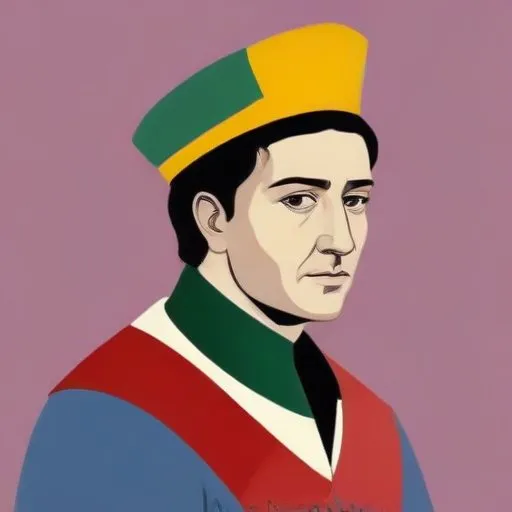
Leonello d'Este, Marquis of Ferrara, is renowned for his patronage of the arts and humanities, earning him the reputation as one of the most cultured and enlightened rulers of the Italian Renaissance. As a scion of the esteemed House of Este, Leonello's life was marked by a passion for knowledge, beauty, and innovation, which he fervently supported throughout his reign.
Born on September 21, 1407, in Ferrara, Italy, Leonello d'Este was the eldest son of
Niccolò III d'Este, Marquis of Ferrara, and Gigliola da Carrara. He received a comprehensive education, mastering Latin, Greek, and Italian literature, as well as mathematics, philosophy, and astronomy. This strong educational foundation laid the groundwork for his future role as a patron and connoisseur of the arts.
Leonello's most notable contribution to the Renaissance was his unwavering support for humanist scholars and artists. He attracted some of the era's most prominent figures, including the poet Ugolino Verino, the historian
Poggio Bracciolini, and the artist Jacopo Bellini, to his court. His patronage enabled the creation of numerous masterpieces, such as the illuminated manuscripts and frescoes that adorned the walls of his palaces.
During his reign, Leonello commissioned various architectural projects, transforming Ferrara into a hub of Renaissance culture. The majestic Castello Estense, a fortified palace that still stands today, was one of his most impressive undertakings. He also refurbished the Palazzo della Ragione, a medieval palace that became the seat of government, and commissioned the construction of the iconic Duomo di Ferrara.
Leonello's personal life was marked by romantic relationships and alliances that strengthened his position as a ruler. He married Margherita Gonzaga, daughter of the Marquis of Mantua, solidifying an important alliance between the two powerful families. He also had several illegitimate children, including his son, Francesco, who would succeed him as Marquis of Ferrara.
Leonello d'Este's reign, which spanned from 1441 to 1450, coincided with a period of great cultural and artistic transformation in Italy. His tireless promotion of the arts and humanities helped establish Ferrara as a beacon of Renaissance culture, attracting scholars, artists, and intellectuals from across the continent. His legacy extends beyond his own lifetime, influencing the development of art, architecture, and literature for centuries to come.
When compared to his contemporaries, such as the Medici family in Florence, Leonello's approach to patronage and cultural development was distinct. While the Medici focused on commerce and finance, Leonello prioritized education, art, and architecture, creating a unique cultural identity for Ferrara.
"The study of letters is the gateway to all virtuous habits and to the knowledge of the universe."
This quote, attributed to Leonello, highlights his commitment to education and the pursuit of knowledge.
Leonello d'Este's cultural legacy continues to inspire contemporary artists, architects, and scholars. His patronage of the arts and his vision for a culturally enriched society have left an indelible mark on the development of Western culture.
- Leonello was an accomplished musician and played the lute.
- He was known for his exceptional horsemanship and maintained a vast stable of horses.
- Ferrara's iconic crenellated walls, built during Leonello's reign, are still visible today.
Leonello's philanthropic endeavors focused on supporting the poor, the elderly, and the sick. He founded hospitals, orphanages, and other charitable institutions, demonstrating his commitment to the welfare of his subjects.
As a champion of education, Leonello established the University of Ferrara, which became a hub of scholarly activity, attracting academics from across Europe. He also founded the Este Library, a renowned collection of manuscripts and rare books that remains an important cultural treasure to this day.
- 1407: Leonello d'Este is born in Ferrara, Italy.
- 1441: Leonello becomes Marquis of Ferrara upon the death of his father, Niccolò III.
- 1443: He marries Margherita Gonzaga, solidifying an alliance with the Marquis of Mantua.
- 1450: Leonello dies, and his son, Francesco, succeeds him as Marquis of Ferrara.
Leonello d'Este's remarkable life and legacy serve as a testament to the power of cultural patronage and visionary leadership. As a champion of the arts, education, and humanity, he has left an indelible mark on the cultural heritage of the Renaissance, continuing to inspire generations to come.