


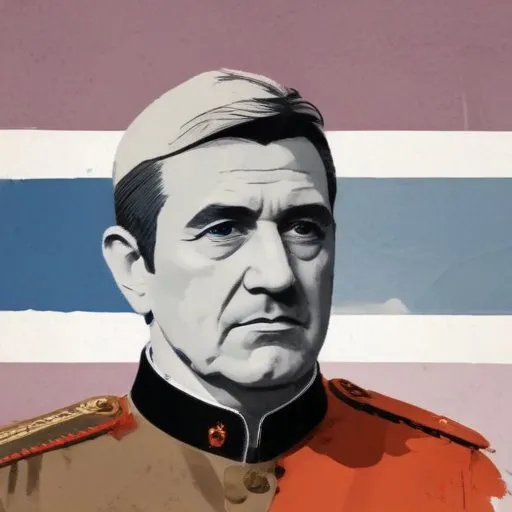
A Greek general and politician who led the country's military during the Balkan Wars and later served as Prime Minister, known for his military victories and nationalistic policies.
Leonidas Paraskevopoulos is revered as a prominent figure in Greek history, distinguished for his exceptional leadership during World War I and his subsequent tenure as a renowned statesman. As the commander-in-chief of the Army of Asia Minor in 1919-1920, he played a pivotal role in Greece's war effort, earning widespread recognition for his military acumen and strategic brilliance.
Born on October 7, 1860, on the island of Kythnos, Paraskevopoulos hailed from a family with roots in Smyrna, Asia Minor. He enrolled in the Hellenic Military Academy and graduated in November 1881 as an Artillery 2nd Lieutenant. His military career spanned several decades, during which he participated in key conflicts, including the Greco-Turkish War of 1897 and the Balkan Wars.
During World War I, Paraskevopoulos rose to prominence as the commander of I Army Corps on the Strymon sector. His exceptional leadership skills and strategic prowess earned him the appointment as commander-in-chief of the Greek Army in October 1918. Following the war, he took command of the Greek forces occupying Smyrna in 1919, in accordance with the Treaty of Sèvres.
In the aftermath of World War I, Paraskevopoulos transitioned into politics, becoming a member of the Greek Senate and serving as its speaker from 1930 to 1932. Throughout his life, he remained committed to public service, leaving an indelible mark on Greek history.
Leonidas Paraskevopoulos' accomplishments have had a lasting impact on Greek society, cementing his position as a national hero. His military brilliance and political acumen have inspired generations, making him a revered figure in Greek history.
His legacy extends beyond the realm of politics and warfare, serving as a testament to the power of dedication, perseverance, and leadership. As a statesman and military leader, Paraskevopoulos embodied the essence of Greek pride and patriotism, leaving behind a rich heritage that continues to inspire and motivate Greeks around the world.
Born in 1871
A Greek general and politician who served as the 130th Prime Minister of Greece, known for his authoritarian regime and opposition to the Axis powers during World War II. He implemented a series of reforms and modernization projects, but also suppressed political opposition and civil liberties.
Born in 1864
A Greek statesman who played a crucial role in shaping modern Greece, leading the country through significant reforms and transformations. He's known for his visionary leadership and diplomatic prowess.
Born in 1918
Greek lawyer and politician who served as the 178th Prime Minister of Greece, known for his efforts to modernize and liberalize the Greek economy. He played a key role in Greece's accession to the European Union.
Born in 1919
Greek economist and politician who served as Prime Minister of Greece, known for his socialist policies and efforts to reduce Greece's reliance on foreign capital. He also played a key role in Greece's accession to the European Union.
Born in 1888
A Greek lawyer, economist, and politician who served as the Prime Minister of Greece from 2009 to 2011, known for his efforts to address the country's debt crisis.
