


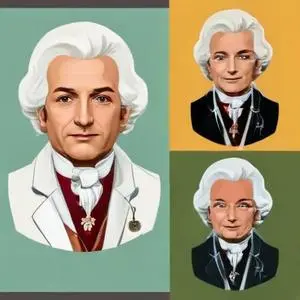
Inventor of percussion, a diagnostic technique where doctors tap on the chest to detect abnormalities, revolutionizing medical diagnosis. This innovation paved the way for modern diagnostic methods.
Leopold Auenbrugger, a pioneering Austrian physician, is credited with inventing percussion as a diagnostic technique, revolutionizing the field of medicine. His groundbreaking discovery empowered doctors to accurately diagnose diseases, earning him the title of one of the founders of modern medicine.
Born on November 19, 1722, in Graz, Styria, Auenbrugger was raised in an environment that fostered his passion for learning. His father, the owner of the inn Zum Schwarzen Mohren, ensured that his son received an excellent education in his native town, followed by further studies at the University of Vienna.
Auenbrugger's innovative technique was inspired by an unlikely source – the practice of testing wine casks in his father's cellar. By applying his ear to the chest and tapping lightly, he discovered that the density of underlying tissues and organs could be assessed. This breakthrough allowed him to plot outlines of the heart, enabling doctors to diagnose diseases with unprecedented accuracy.
In a booklet, Auenbrugger shared his discovery with the medical community. Unfortunately, his work was initially met with indifference. Undeterred, he continued to refine his technique through meticulous research and experimentation.
During his 10-year tenure at the Spanish Military Hospital in Vienna, Auenbrugger conducted extensive research on percussive diagnosis. He injected fluid into the pleural cavity, demonstrating the precision of his technique in determining the limits of fluid present. This led to the identification of Auenbrugger's sign, a bulging of the epigastric region in cases of large effusions of the pericardium.
Auenbrugger's later work focused on tuberculosis, where he pioneered methods for detecting cavities in the lungs. His contributions significantly improved diagnostic capabilities, ultimately saving countless lives.
Leopold Auenbrugger's pioneering work laid the foundation for modern medicine. His invention of percussion diagnosis paved the way for subsequent medical breakthroughs, cementing his status as a trailblazer in the field. His legacy continues to inspire future generations of medical professionals.
Auenbrugger's remarkable journey, marked by perseverance and innovation, has left an indelible mark on the world of medicine. His legacy serves as a testament to the power of human ingenuity and the importance of pushing the boundaries of medical knowledge.
"The doctor must be able to observe, and not only to perceive, but to understand, what he observes." - Auenbrugger's words of wisdom reflect his commitment to advancing medical knowledge and improving patient care.
As we reflect on Auenbrugger's remarkable life and achievements, we are reminded of the profound impact that one person can have on the world of medicine. His groundbreaking discovery continues to inspire and influence medical professionals to this day.
Born in 1728
Discovered magnesium and isolated carbon dioxide, making significant contributions to the field of chemistry.
Born in 1710
Pioneering physician and chemist who discovered the properties of carbon dioxide and developed the theory of latent heat, making significant contributions to the fields of chemistry and medicine.
Born in 1743
Father of modern chemistry, discovered oxygen, and developed a systematic method of chemical nomenclature. He laid the foundation for modern chemistry and paved the way for future scientific discoveries.
Born in 1707
Developed the system of binomial nomenclature, which is still used today to classify and name living organisms. This system has had a profound impact on the fields of biology, ecology, and conservation.
Born in 1825
A pioneering neurologist and psychologist who laid the groundwork for modern psychiatry, particularly in the study of hysteria and hypnosis.
Born in 1821
A pioneer in modern medicine, he founded the field of social medicine, emphasizing the importance of social and environmental factors on health, and made significant contributions to cellular pathology.
Born in 1849
A Russian physiologist and physician who discovered the concept of classical conditioning, where he demonstrated that animals can learn to associate stimuli with a particular response, revolutionizing our understanding of behavior. His work laid the foundation for behavioral psychology and continues to influence fields like education and advertising.
Born in 1856
Pioneering psychoanalyst who developed theories on the subconscious mind, childhood experiences, and the structure of personality, revolutionizing our understanding of human behavior and psychology.
