


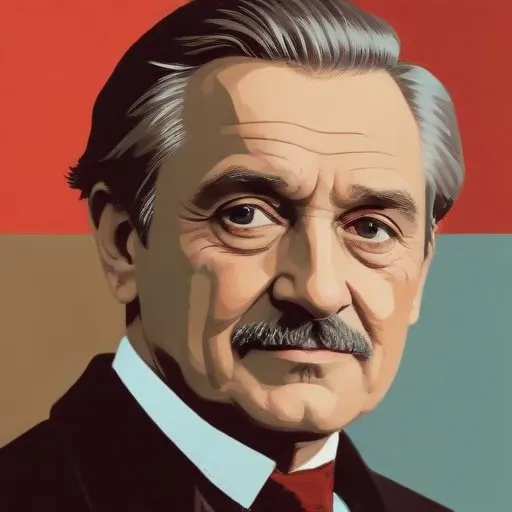
A Polish-English historian and philosopher who explored the intersection of philosophy, politics, and history, particularly in the context of Marxism and communism. He's known for his critiques of totalitarianism and his advocacy for democratic values.
Leszek Kołakowski was a Polish philosopher and historian of ideas, best known for his groundbreaking critical analyses of Marxist thought. His magnum opus, the three-volume "Main Currents of Marxism" (1976), is a seminal work that exposed the intellectual and philosophical flaws of Marxist ideology.
Kołakowski was born on October 23, 1927, in Radom, Poland. During World War II, he could not attend formal school due to the German occupation, but he continued to read and learn through private lessons, eventually passing his school-leaving examinations as an external student in the underground school system. After the war, he studied philosophy at the University of Łódź and the University of Warsaw, earning his doctorate in 1953 with a focus on Spinoza from a Marxist perspective.
In his early years, Kołakowski was an ardent communist and even signed a denunciation against Władysław Tatarkiewicz, a prominent Polish philosopher. However, as he delved deeper into Marxist thought, he began to develop critical perspectives on the ideology. This led to a gradual shift away from communism and towards a more nuanced understanding of philosophy and history.
Kołakowski's magnum opus, "Main Currents of Marxism," is a comprehensive and critical analysis of Marxist thought. The three-volume work, published in 1976, is a towering achievement that exposes the intellectual and philosophical flaws of Marxist ideology. The work was praised for its erudite scholarship and its ability to pierce the veil of ideological dogma.
Due to his criticism of Marxism and the Communist state system, Kołakowski was effectively exiled from Poland in 1968. He spent most of the remainder of his career at All Souls College, Oxford. During this period, he increasingly focused on religious questions, exploring the intersection of philosophy and faith.
Kołakowski's work had a profound impact on modern society, particularly in Poland. His critical analyses of Marxism helped inspire the Solidarity movement, which played a significant role in bringing about the collapse of the Soviet Union. Bronisław Geremek, a prominent Polish politician, hailed Kołakowski as "the awakener of human hopes."
Kołakowski's philosophical contributions were centered on his critique of Marxist thought and his exploration of the relationship between philosophy and faith. He believed that history was essential for understanding human identity, stating, "We learn history not in order to know how to behave or how to succeed, but to know who we are."
Leszek Kołakowski's legacy is that of a maverick philosopher who dared to challenge the dominant ideology of his time. His work continues to inspire scholars and thinkers around the world, and his influence can be seen in the many fields he touched, from philosophy and history to politics and religion.
Born in 1909
A Latvian-English historian and philosopher who explored the intersection of philosophy, history, and politics, and is renowned for his work on the Enlightenment, liberty, and the nature of humanity.
Born in 1910
A prominent logical positivist, he championed the idea that only verifiable statements are meaningful, and his book "Language, Truth, and Logic" remains a seminal work in 20th-century philosophy.
97 Years Old
A moral philosopher who challenged traditional ethics and explored the complexities of human identity, known for his critiques of moral theory and advocacy for a more nuanced understanding of human experience.
Born in 1906
A 20th-century philosopher and theorist who explored the nature of power, politics, and humanity, particularly in the context of totalitarianism and the Holocaust.
Born in 1905
A prominent public intellectual who wrote extensively on politics, history, and philosophy, offering insightful critiques of totalitarianism and communism. Known for his advocacy of liberal democracy and nuanced understanding of modern society.
