


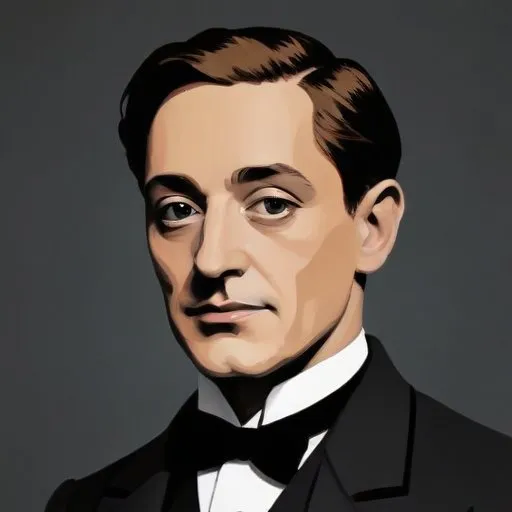
A scandalous figure in Oscar Wilde's life, known for his poetry and being the inspiration behind Wilde's imprisonment. His beauty and charm captivated many in Victorian England.
Lord Alfred Douglas, also known as Bosie Douglas, is famously remembered as the lover of Oscar Wilde, the renowned Irish poet and playwright. However, his life and works extend far beyond this notable relationship, revealing a complex and multifaceted individual who was a poet, journalist, and Catholic convert, embroiled in controversies that continue to fascinate and scandalize to this day.
Born on October 22, 1870, at Ham Hill House in Powick, Worcestershire, Douglas was the third son of John Douglas, 9th Marquess of Queensberry, and his first wife, Sibyl Montgomery. His mother, who called him Bosie, a derivative of "boysie," was his favorite child. After his parents' divorce in 1887, Douglas was educated at Wixenford School, Winchester College, and Magdalen College, Oxford, where he edited the undergraduate journal, The Spirit Lamp, which carried a homoerotic subtext.
Douglas's close but tumultuous relationship with Oscar Wilde began at Oxford, and it was during this time that Wilde's father-in-law, the Marquess of Queensberry, publicly accused Wilde of homosexuality. Wilde sued for criminal libel, but intimate notes were discovered, leading to his imprisonment. Upon his release, Wilde briefly lived with Douglas in Naples, but they had separated by the time Wilde died in 1900.
Douglas wrote several books of verse, some of which are classified as homoerotic Uranian poetry. One of his most notable works is "Two Loves," which features the infamous phrase "The love that dare not speak its name," often misattributed to Wilde. Douglas's poetry is characterized by its sensuality, beauty, and openness about same-sex relationships, making him a pioneering figure in the Uranian movement.
In 1911, Douglas converted to Catholicism, an event that marked a significant shift in his perspective on his sexuality. He publicly repudiated homosexuality and expressed openly antisemitic views in the Catholic magazine Plain English. Later, he rejected the policies of Nazi Germany, despite his earlier prejudices.
Douglas was jailed for libeling Winston Churchill over claims of World War I misconduct. This episode, along with his earlier controversies surrounding his relationship with Wilde, cemented his reputation as a figure of scandal and intrigue.
In 1902, Douglas married poet Olive Custance and had a son, Raymond. He died on March 20, 1945, leaving behind a complex and multifaceted legacy that continues to fascinate and inspire. Despite his controversies, Lord Alfred Douglas remains an important figure in the history of LGBTQ+ literature and culture.
Lord Alfred Douglas's life serves as a testament to the power of human complexity, embodying both the beauty and the brutality of the human experience. His legacy continues to captivate and challenge us, inviting us to reexamine our understandings of love, identity, and desire.
Born in 1854
A witty and flamboyant literary mastermind, renowned for crafting clever, humorous, and poignant works that continue to delight audiences with their clever wordplay and societal commentary.
Born in 1685
Wrote influential satirical plays and poems that critiqued 18th-century British society, particularly with his famous work "The Beggar's Opera".
Born in 1918
A renowned literary critic and biographer, celebrated for his meticulously researched and engagingly written studies of iconic authors like James Joyce and Oscar Wilde.
