


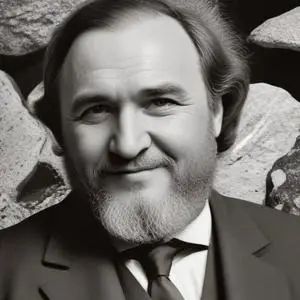
A pioneering scientist who studied fossils and glaciers, making groundbreaking discoveries about the Ice Age and the classification of species.
Louis Agassiz, a Swiss-born American biologist and geologist, is renowned for his groundbreaking contributions to the field of natural history, particularly in the areas of ichthyology, glaciology, and historical geology. His painstaking observational data gathering and analysis have left an indelible mark on the scientific community, earning him recognition as a leading scholar of his time.
Born on May 28, 1807, in the village of Mtier, Switzerland, Agassiz was the son of a Protestant clergyman, Louis Rudolphe, and his wife, Rose Mayor. He received his early education at home before attending secondary school in Bienne and later pursuing higher studies at the Universities of Zurich, Heidelberg, and Munich, where he earned his PhD and medical degree, respectively.
Agassiz's academic pursuits led him to Paris, where he studied under the tutelage of Georges Cuvier and Alexander von Humboldt. This experience laid the foundation for his later work, including his appointment as professor of natural history at the University of Neuchâtel. In 1847, he emigrated to the United States, where he became professor of zoology and geology at Harvard University, heading its Lawrence Scientific School and founding the Museum of Comparative Zoology.
His monumental works include multivolume research books, such as Recherches sur les poissons fossiles and Contributions to the Natural History of the United States, which showcased his meticulous research and classification of fossil fish, including the megalodon.
Agassiz's work was not without controversy, as his theories on human, animal, and plant polygenism have been criticized for implicitly supporting scientific racism. Despite this, his contributions to the scientific community remain significant, and his work continues to inspire new generations of researchers and scholars.
Agassiz's legacy extends beyond the academic realm, influencing modern society in subtle yet profound ways. His pioneering work in glaciology and historical geology has paved the way for our understanding of climate change and the natural world. Moreover, his commitment to empirical observation and analysis has raised the bar for scientific inquiry, shaping the course of research and discovery in diverse fields.
Louis Agassiz's life and work are a testament to the power of dedicated research and analysis. His contributions to the fields of biology, geology, and related areas have left an indelible mark on the scientific community. As we continue to grapple with the complexities of our natural world, Agassiz's pioneering spirit and commitment to empirical observation serve as a beacon of inspiration, guiding us toward new discoveries and a deeper understanding of the world around us.
Born in 1809
Developed the theory of evolution through natural selection, revolutionizing our understanding of life on Earth. This groundbreaking idea transformed the fields of biology, ecology, and beyond.
Born in 1744
A French soldier, biologist, and academic who developed a theory of inheritance of acquired characteristics, proposing that organisms adapt to their environment and pass on those traits to their offspring.
Born in 1769
Founded the field of comparative anatomy, establishing extinction as a fact and creating a framework for understanding the natural world through fossil records.
Born in 1810
A pioneering botanist who contributed significantly to the development of American botany, particularly in the fields of plant classification and evolution.
Born in 1785
A pioneering ornithologist and artist, famous for meticulously illustrating and documenting North American bird species in his iconic book "The Birds of America". His work remains a cornerstone of ornithology and wildlife art.
Born in 1769
A pioneering geographer and explorer who mapped much of South America and discovered the Caspian Sea's connection to the Black Sea, greatly advancing our understanding of the natural world.
Born in 1817
A 19th-century thinker who advocated for simple living, civil disobedience, and individualism, inspiring generations to reevaluate their relationship with nature and society.
Born in 1803
A leading figure in the Transcendentalist movement, he advocated for individualism, self-reliance, and nature-inspired spirituality through his essays and poetry. His ideas continue to influence American thought and culture.
