


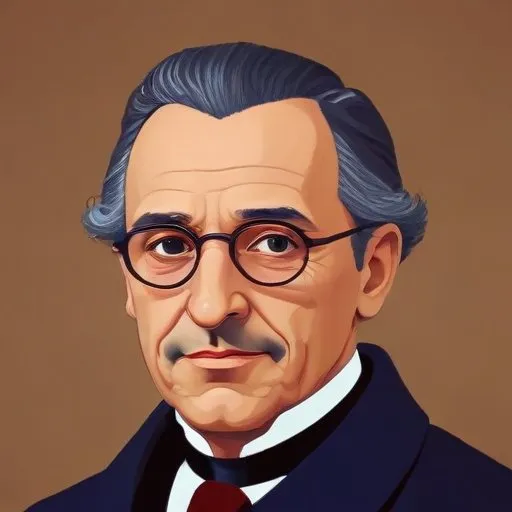
Developed the clavichord, a precursor to the piano, and wrote extensively on philosophy, mathematics, and music. He's also known for his criticism of Isaac Newton's theories.
Louis Bertrand Castel, a French mathematician and Jesuit priest, is renowned for his groundbreaking work in the field of Optics, particularly his treatise on the "Melody of Colors." Born on November 5, 1688, in Montpellier, France, Castel's intellectual pursuits spanned mathematics, natural philosophy, and literature, earning him a prominent place in the annals of scientific history.
Castel entered the Jesuit order in 1703, dedicating himself to the pursuit of knowledge and spirituality. His early studies focused on literature, but he soon became enamored with mathematics and natural philosophy. In 1720, he moved to Paris at the behest of Bernard de Fontenelle, where he became the science editor of the esteemed Jesuit Journal de Trévoux.
Castel's magnum opus, Optique des couleurs (1740), revolutionized the understanding of light and color. In this seminal work, he proposed that colors could be arranged in a harmonious sequence, much like the notes of music. This pioneering concept laid the foundation for modern color theory and its applications in art, design, and technology.
Castel's contributions to science and philosophy were multifaceted and far-reaching. His notable works include:
Castel's philosophical approach was characterized by his desire to reconcile disparate fields and viewpoints. He employed analogical thinking to understand the physical and moral worlds, seeking to uncover the hidden harmonies that govern the universe. This holistic approach allowed him to tackle complex problems in physics, mathematics, morals, aesthetics, theology, and history, earning him a reputation as a polymath.
Louis Bertrand Castel's contributions to the scientific community have been profound and lasting. His work on the harmony of colors has inspired generations of artists, designers, and scientists. His philosophical approach, which emphasized the importance of human experience and free will, continues to influence contemporary debates in ethics, morality, and the nature of reality.
In the words of Castel himself, "True science should focus on readily experienced and described phenomena." His commitment to empirical observation and critical thinking has left an indelible mark on the history of science, ensuring his legacy as a pioneer in the quest for knowledge and understanding.
Born in 1596
Developed influential philosophical and mathematical concepts, including the famous phrase "I think, therefore I am," and laid the foundation for modern Western philosophy.
Born in 1749
Developed nebular hypothesis of the origin of the solar system and formulated Laplace's equation, a fundamental concept in mathematics and physics. He's considered the founder of celestial mechanics.
Born in 1736
Developed calculus, number theory, and celestial mechanics, making significant contributions to the fields of mathematics and astronomy.
Born in 1707
Pioneering mathematician and physicist who made immense contributions to fields like calculus, number theory, and optics, shaping the course of modern mathematics and physics.
Born in 1646
Developed calculus independently of Isaac Newton, and made major contributions to the fields of philosophy, politics, and history.
Born in 1623
A 17th-century genius who made major contributions to mathematics, physics, and philosophy, inventing the mechanical calculator and developing the theory of probability. His writings also explored the human condition and faith.
Born in 1775
French physicist and mathematician who discovered the polarization of light and developed the theory of partial reflection, making significant contributions to the field of optics.
Born in 1789
Developed rigorous mathematical theories and introduced concepts like convergence and continuity, revolutionizing calculus and paving the way for modern mathematics.
