


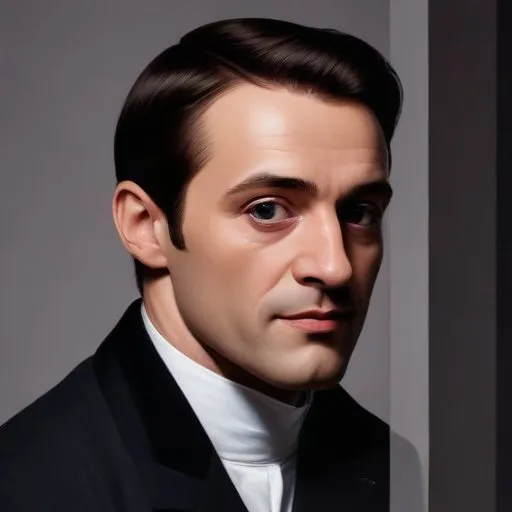
A French painter of portraits and historical scenes, known for his delicate and expressive style, which captured the essence of his subjects. He was a prominent artist during the French Revolution and Napoleon's reign.
Louis Hersent was a French painter renowned for his captivating depictions of ancient mythology and history. Born on March 10, 1777, in Paris, Hersent's artistic talents propelled him to the forefront of the French art scene, earning him the esteemed Prix de Rome in 1797.
Hersent began his artistic journey as a pupil of the influential French painter, Jacques-Louis David. This tutelage laid the foundation for Hersent's mastery of neoclassicism, a style that would become synonymous with his work. Under David's guidance, Hersent honed his skills, which ultimately led to his triumph in the Prix de Rome competition.
Hersent's breakthrough came in 1802 when he showcased his painting, Metamorphosis of Narcissus, at the Salon. This piece marked the beginning of a long and fruitful career, during which he exhibited his works consistently until 1831.
Hersent's influence extended beyond his own artistic creations, as he taught a generation of painters who would go on to make their mark on the art world. His pupils included notable artists such as Louis-Eugène Bertier, Auguste Bigand, and Henri Joseph Constant Dutilleux, among others. Through his teachings, Hersent ensured that his artistic vision and neoclassical style would live on.
Hersent's paintings often explored themes drawn from ancient mythology and history. Some of his most celebrated works include Achilles parting from Briseis, Atala dying in the arms of Chactas, and Incident of the life of Fénelon. The latter, painted in 1810, found a prestigious home at Malmaison. His Passage of the Bridge at Landshut, also completed in 1810, is now housed at Versailles.
Hersent's talent and dedication earned him numerous accolades, including the honor of being made an officer of the Legion of Honour. He also received a medal of honour for his work, The Abdication of Gustavus Vasa, exhibited at the Salon of 1819. This recognition solidified his position as a prominent figure in the French art world.
In 1821, Hersent married Louise-Marie-Jeanne Mauduit, and the couple lived a life filled with art, teaching, and recognition. As he grew older, Hersent continued to create, leaving behind a rich legacy that would inspire future generations of artists. He passed away on October 2, 1860, leaving an indelible mark on the world of French art.
Today, Louis Hersent's works remain a testament to his artistic genius and his ability to bring ancient tales to life. As a painter, teacher, and artist, Hersent left an indelible mark on the French art world, ensuring his legacy will continue to inspire and captivate audiences for generations to come.
Born in 1748
A French painter and illustrator who revolutionized Neoclassicism with his realistic and emotive works, creating iconic pieces like "Oath of the Horatii" and "Napoleon Crossing the Alps".
Born in 1770
A prominent Neoclassicist painter, renowned for his elegant and refined portraits of European aristocracy, capturing the essence of his subjects with precision and subtlety.
Born in 1771
A French Neoclassicist painter who created dramatic, emotionally charged scenes, often depicting Napoleon's military campaigns and heroic events. His works are characterized by vivid colors and intense lighting.
Born in 1780
A renowned French Neoclassicist painter and illustrator, celebrated for his exquisite portraits and historical scenes that epitomize elegance and refinement. His work continues to inspire artists and art enthusiasts alike.
Born in 1791
A Romantic-era master of dramatic and emotionally charged art, known for his powerful depictions of horses and the human experience.
Born in 1798
A Romantic-era master of expressive brushstrokes and vivid color, creating iconic works that captured the drama and emotion of historical and literary scenes.
Born in 1732
A prolific Rococo painter and etcher, renowned for his delicate, whimsical, and often erotic works that capture the carefree spirit of 18th-century French aristocracy. His art often featured lush landscapes, gentle colors, and playful scenes of love and leisure.
