


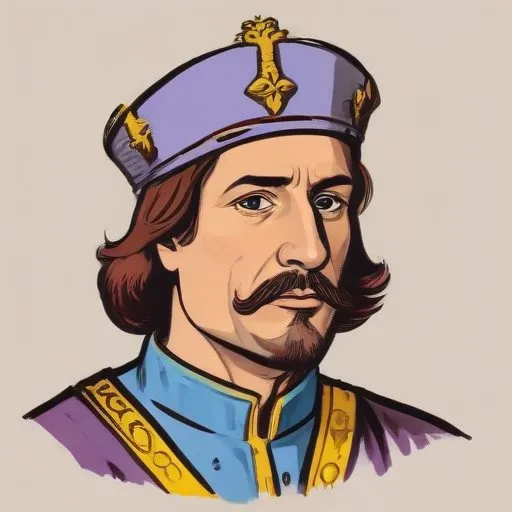
Ruler of Flanders from 1346 to 1384, known for his military campaigns and territorial expansions, particularly the acquisition of the County of Artois.
Louis II, Count of Flanders, also known as Louis of Male, was a prominent figure in medieval Europe, known for his rule over Flanders, Nevers, and Rethel from 1346, as well as Count of Artois and Burgundy from 1382 until his death in 1384.
Throughout his reign, Louis II navigated the complex web of alliances and rivalries between European powers, including the Kingdom of England, the Kingdom of France, and the Duchy of Brabant, often finding himself caught in the middle of their conflicts.
Born on October 25, 1330, in Male, Louis II was the son of Count Louis I of Flanders and Countess Margaret I of Burgundy, daughter of King Philip V of France.
He was baptized by Bishop Pierre Roger, later Pope Clement VI, and went on to marry Margaret, daughter of Duke John III of Brabant, in a union arranged by his father to strengthen ties with the Imperial Duchy of Brabant.
The couple had a daughter, Countess Margaret III of Flanders (1348-1405), and Louis also had several illegitimate sons, three of whom were killed at the Battle of Nicopolis.
Following the death of his father at the Battle of Crécy in 1346, Louis II inherited the French counties of Flanders, Nevers, and Rethel.
In the Anglo-French conflict, the Flanders guilds, dependent on the English wool trade, forced Louis to recognize King Edward III of England as his overlord and arranged an engagement to the daughter of the English king, Isabella.
However, Louis managed to avoid this by fleeing to the court of King Philip VI of France, where he formed an alliance with the French monarch.
In 1347, he married Margaret of Brabant, sparking a revolt in Ghent, but was eventually able to return to Flanders and succeed his father.
Louis II was known for his skilled diplomacy, often navigating complex conflicts between rival powers.
In 1350, he gained credibility by openly refusing to pay homage to the newly ascended King John II of France.
When his father-in-law John III died without male heirs in 1355, Louis moved to claim the Duchy of Brabant, but was unable to wrest it from his sister-in-law Joanna.
Despite this, Louis managed to defeat the Brabantian forces in the Battle of Scheut near Anderlecht in 1356 and capture the cities of Mechelen, Brussels, Antwerp, and Leuven.
Louis II's legacy is marked by his ability to navigate the complex web of alliances and rivalries in medieval Europe, often finding himself caught in the middle of conflicts between powerful nations.
Despite the challenges he faced, Louis managed to maintain control over his territories and secure a lasting legacy for himself and his family.
Today, Louis II is remembered as a skilled diplomat and leader who played a significant role in shaping the course of medieval European history.
