


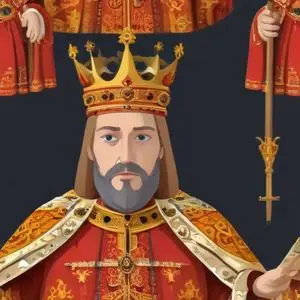
King of England from 1327 to 1377, he established the Order of the Garter and launched the Hundred Years' War with France, marking a significant period in English history.
Edward III of England, also known as Edward of Windsor, is renowned for his military success and for restoring royal authority after the tumultuous reign of his father, Edward II. His fifty-year reign, one of the longest in English history, transformed the Kingdom of England into a formidable military power in Europe.
Edward III was crowned at the tender age of fourteen after his father's deposition by his mother, Isabella of France, and her lover, Roger Mortimer. At seventeen, he led a successful coup d'état against Mortimer, the de facto ruler of England, and began his personal reign.
After a successful campaign in Scotland, Edward declared himself the rightful heir to the French throne, sparking the Hundred Years War (1337-1453). This first phase of the war, known as the Edwardian War, saw England achieve remarkable victories, including the battles of Crécy and Poitiers in 1356. The subsequent Treaty of Brétigny granted England significant territorial gains, and Edward renounced his claim to the French throne.
Edward III was a complex and multifaceted individual, known for his temperamental nature and his conviction that he possessed the royal touch, a belief that he could heal through divine intervention. He was also capable of extraordinary clemency. A conventional medieval king with a passion for warfare, he had a broad range of non-military interests.
Edward III's reign had a profound impact on English history, shaping the evolution of the English Parliament and legislation. His military campaigns and diplomatic efforts transformed England into a powerful nation, establishing a legacy that endured for centuries. Despite facing domestic strife and foreign policy setbacks in his later years, Edward III remains one of the most admired and influential monarchs in English history.
Edward III's legacy extends beyond the medieval period, shaping the development of modern England and influencing the course of European history. His military campaigns, diplomatic efforts, and administrative reforms continue to be studied and admired by historians and scholars today.
Edward III's achievements are often compared to those of his contemporaries, including King Philip VI of France and King David II of Scotland. While each monarch faced unique challenges and opportunities, Edward III's military success and administrative reforms set him apart as a visionary leader who transformed the Kingdom of England.
Born in 1284
The king whose disastrous reign led to his eventual deposition and mysterious death, remembered for his alleged homosexual relationships and power struggles with nobles.
Born in 1052
King of France from 1060 to 1108, known for his military campaigns and conflicts with the Church, particularly his excommunication by Pope Urban II.
Born in 1340
A powerful and wealthy medieval English nobleman, known for his immense influence on English politics and his role in the Hundred Years' War. He was also a patron of the arts and a founder of Trinity College, Cambridge.
Born in 1330
The eldest son of King Edward III, he was a renowned military leader and heir to the English throne, famous for his victories in the Hundred Years' War, particularly the Battle of Poitiers. He was also known for his chivalry and founding the Order of the Garter.
Born in 1367
The last king of the House of Plantagenet, deposed in a coup, known for his extravagance and tyranny, leading to his downfall and the rise of the Lancastrian dynasty.
Born in 1133
King of England from 1154 to 1189, known for establishing a strong centralized government, reforming the English church, and his tumultuous relationships with Thomas Becket and his sons.
