


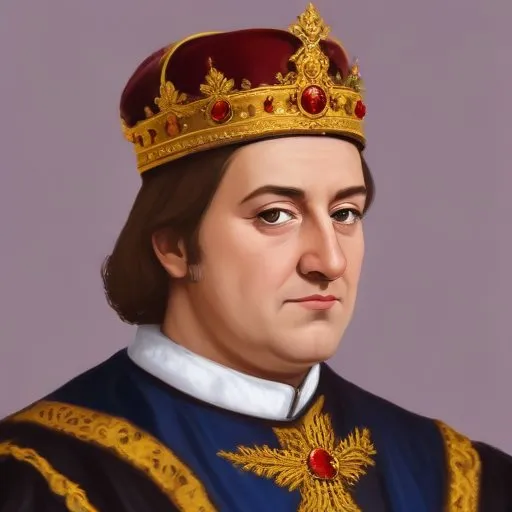
A powerful German king who ruled the Holy Roman Empire in the 14th century, known for his conflicts with the papacy and his role in the development of the German monarchy.
Known as the last Bavarian to hold the title of King of Germany until 1742, Louis IV, Holy Roman Emperor, was a powerful and influential figure of the 14th century. As the King of the Romans, King of Italy, and Holy Roman Emperor, Louis IV left an indelible mark on European history, marked by controversy, power struggles, and significant contributions to the Holy Roman Empire.
Born in Munich in 1282, Louis IV was the son of Louis II, Duke of Upper Bavaria and Count Palatine of the Rhine, and Matilda, a daughter of King Rudolph I. His early education in Vienna and coregency with his brother Rudolf I in Upper Bavaria set the stage for his future rise to power.
In 1314, Louis IV's election as King of Germany sparked controversy, as his Habsburg cousin Frederick the Fair was simultaneously elected king by a separate set of electors. The dispute ultimately led to the Battle of Mhldorf in 1322, where Louis IV emerged victorious, defeating Frederick and solidifying his claim to the throne.
Throughout his reign, Louis IV made significant contributions to the Holy Roman Empire, including:
Louis IV's reign was not without controversy, marked by conflicts with the French Pope John XXII, who excommunicated him. In response, Louis IV attempted to depose the pope and install an antipope, further straining relations between the Empire and the Church.
Throughout his life, Louis IV was committed to his family and territories, ensuring the continuation of his legacy through his children and territorial expansions. His reign marked a significant turning point in European history, shaping the course of the Holy Roman Empire for centuries to come.
In conclusion, Louis IV, Holy Roman Emperor, was a complex figure whose life was marked by power struggles, controversy, and significant contributions to the Holy Roman Empire. As a powerful leader and shrewd politician, Louis IV left an indelible mark on European history, cementing his place as one of the most influential figures of the 14th century.
Born in 1284
The king whose disastrous reign led to his eventual deposition and mysterious death, remembered for his alleged homosexual relationships and power struggles with nobles.
Born in 1052
King of France from 1060 to 1108, known for his military campaigns and conflicts with the Church, particularly his excommunication by Pope Urban II.
Born in 1361
King of Bohemia from 1378 to 1419, known for his tumultuous reign marked by power struggles, conflicts, and a Black Death pandemic. He was a key figure in the Luxembourg dynasty.
