


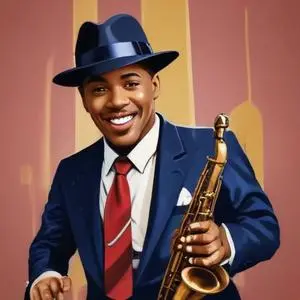
A pioneer of jump blues and rhythm and blues, known for blending jazz, blues, and swing to create a unique sound that influenced many famous musicians, including Chuck Berry and Little Richard.
Louis Jordan, known as the King of the Jukebox, was an American saxophonist, multi-instrumentalist, songwriter, and bandleader who reigned supreme from the late 1930s to the early 1950s. He was the master of jump blues, a genre that blended jazz, blues, and boogie-woogie to create an infectious, dance-oriented sound.
Born on July 8, 1908, in Brinkley, Arkansas, Jordan began his musical journey at an early age, learning to play the piano, clarinet, and saxophone. He formed his first band, the Serenaders, in 1930, which eventually evolved into the Tympany Five, his signature group.
Jordan's unique sound, characterized by shouted vocals, earthy lyrics, and a strong emphasis on rhythm, caught on with the masses, and he became a jukebox sensation in the 1940s. His hits, such as "Ain't Nobody Here But Us Chickens" and "Choo Choo Ch'Boogie," topped the charts, earning him a place in the Rock and Roll Hall of Fame as an early influence in 1987.
Jordan was a multi-instrumentalist, proficient in playing the alto saxophone, piano, clarinet, and electric guitar. He was also an accomplished singer, known for his comedic flair and ability to duet with some of the biggest stars of his time, including Bing Crosby, Ella Fitzgerald, and Louis Armstrong.
Jordan's charisma extended beyond the music world, and he made a successful transition to film, appearing in 14 three-minute Soundies and several feature films, including "Follow the Boys" and "Swing Parade" in 1946. His musical short "Caldonia" (1945) spawned three more feature films, showcasing his band and cementing his status as a Hollywood personality.
Jordan's innovative approach to music paved the way for the development of rhythm and blues, rock and roll, and urban blues. His influence can be seen in the works of artists such as Chuck Berry, Little Richard, and Ray Charles, who drew inspiration from his distinctive style.
Louis Jordan's impact on American music is immeasurable. He was a true pioneer, breaking down genre boundaries and pushing the limits of what was possible in popular music. His legacy continues to inspire new generations of musicians and fans alike, solidifying his place as one of the most important figures in the history of American music.
Through his innovative spirit, captivating stage presence, and enduring legacy, Louis Jordan remains an icon of American music, leaving an indelible mark on the world of jazz, blues, and rock and roll.
Born in 1915
Legendary jazz vocalist and actress known for her expressive, emotive singing style and iconic songs like "God Bless the Child" and "Strange Fruit".
Born in 1917
A virtuosic jazz vocalist known for her pure, expressive tone, impeccable phrasing, and incredible scat singing abilities. She won 13 Grammy Awards and recorded over 200 albums.
Born in 1904
A legendary jazz pianist and bandleader who led a iconic orchestra, blending swing and blues to create a unique sound that influenced generations of musicians. Known for his distinctive "less-is-more" style and hits like "April in Paris" and "One O'Clock Jump".
Born in 1899
A legendary jazz pianist, composer, and bandleader who revolutionized the genre with his unique style and iconic compositions, such as "Take the A Train" and "Mood Indigo".
Born in 1907
A charismatic jazz singer and bandleader who led the Orchestra at the Cotton Club, known for energetic stage performances and hits like "Minnie the Moocher" and "Reefer Man".
Born in 1909
A virtuosic clarinetist and bandleader, known as the "King of Swing," who revolutionized jazz music with his energetic and sophisticated style, leading a racially integrated orchestra in the 1930s.
Born in 1910
A virtuosic clarinetist and innovative bandleader, he revolutionized the swing era with his unique sound and iconic hits like "Begin the Beguine" and "Stardust".
Born in 1904
A legendary trombonist, composer, and bandleader who led one of the most popular big bands of the 1930s and 1940s, creating iconic hits like "In the Mood" and "Moonlight Serenade".
