


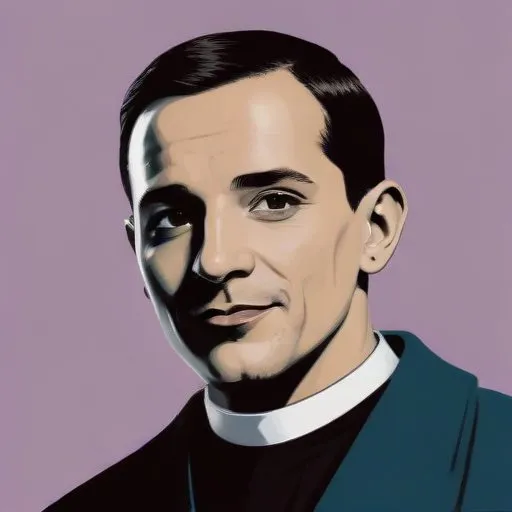
A 17th-century French priest and scholar who cataloged and preserved ancient Greek and Roman texts, making classical knowledge accessible to modern scholars.
Louis Morri, a French priest and encyclopedist, is best known for his monumental work, Le Grand Dictionaire historique, ou le mélange curieux de l'histoire sacrée et profane, a comprehensive encyclopedia that focused on historical and biographical articles. Published in 1674, this groundbreaking work cemented Morri's legacy as one of the pioneering encyclopedists of his time.
Born on March 25, 1643, in Bargemon, a village in Provence, Morri's family roots date back to his great-grandfather, Joseph Chatranet, who settled in Provence under King Charles IX of France. Morri pursued his education in humanities in Draguignan and later in rhetoric and philosophy at the Jesuit College of Aix-en-Provence.
During his stay in Lyon, Morri published several works, including the translation of Alonso Rodriguez's La pratique de la perfection chrétienne et religieuse in 1667. It was likely in Lyon that he met Samuel Chappuzeau, who inspired him to write his encyclopedia. This encounter marked the beginning of Morri's journey as an encyclopedist.
In 1675, Morri accompanied his bishop to Paris, where he became acquainted with Simon Arnauld, Marquis de Pomponne, then the minister of foreign affairs. Three years later, he was hired as a tutor for Pomponne's children, allowing him to work on the second edition of his encyclopedia.
Tragically, Morri passed away in 1680, midway through the printing of the second edition of his encyclopedia, due to tuberculosis. However, his work lived on, and the posthumous two-volume edition of 1681 was revised and expanded upon.
Morri's encyclopedia was a pioneering work that laid the foundation for future encyclopedists. His dedication to historical and biographical articles set a new standard for encyclopedic writing. Though his life was cut short, his legacy continues to inspire and educate generations to come.
Louis Morri's remarkable contributions to the world of encyclopedias have left an indelible mark on the literary world. His dedication to preserving historical and biographical knowledge continues to inspire future generations of scholars and researchers.
Born in 1632
A 17th-century Benedictine monk and scholar who pioneered paleography, the study of ancient handwriting, and developed a scientific approach to historical research. He's known for his meticulous work in authenticating medieval manuscripts.
Born in 1768
A French historian and politician who served as Minister of Foreign Affairs, known for his influential writings on French history and politics, shaping the country's identity and foreign policy.
Born in 1694
A witty and insightful 18th-century writer and philosopher who used satire to critique societal norms and advocate for reason, tolerance, and human rights.
Born in 1712
A pioneering thinker who shaped modern democracy and education with his ideas on social contracts, general will, and the importance of early childhood education. His writings influenced the French Revolution and modern political thought.
Born in 1689
A French lawyer and philosopher who developed the concept of separation of powers, which divides a government into legislative, executive, and judicial branches to prevent abuse of power. His ideas greatly influenced modern democracy.
Born in 1717
A French Enlightenment thinker who made significant contributions to mathematics, physics, and philosophy, particularly in the fields of fluid dynamics and the study of vibrating strings. He's also known for his work on the Encyclopedia, a comprehensive reference work that aimed to compile all knowledge of the time.
