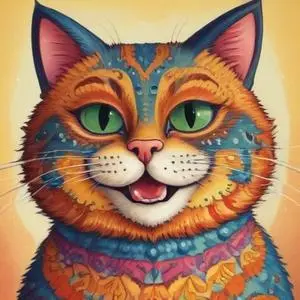
Louis Wain: The Cat's Meow of Illustrators
The Feline Fusionist
Louis Wain is renowned for his whimsical and anthropomorphised cat illustrations, which captured the hearts of many during the late 19th and early 20th centuries. His artwork, characterized by its vibrant colors, playful compositions, and, of course, adorable feline friends, has become synonymous with the concept of anthropomorphic art.
Early Life and Inspiration
Wain was born on August 5, 1860, in Clerkenwell, London, to a family of artists and craftsmen. His maternal grandfather, Louis Boiteux, was a skilled artist, which likely influenced Wain's early interest in art. Despite being born with a cleft lip and experiencing poor health during his childhood, Wain's artistic talents flourished, and he went on to study at the West London School of Art.
The Rise to Fame
In 1881, Wain sold his first illustration, marking the beginning of a prolific career that would span several decades. He soon gave up his teaching position at the West London School of Art to become a full-time illustrator, producing hundreds of drawings and paintings for periodicals and books. His work appeared in popular publications, such as
Louis Wain's Annual, which ran from 1901 to 1921.
A Life of Love, Loss, and Creativity
Wain's personal life was marked by both joy and tragedy. In 1884, he married Emily Richardson, but she passed away just three years later. He then moved to the Kent coast with his mother and five sisters, where he continued to produce art. During this time, he also briefly ventured into ceramics and animated cartoons. Despite his popularity and prolific output, Wain struggled financially, partly due to selling his work cheaply and relinquishing copyright.
The Later Years and Legacy
Tragedy struck again in 1914 when Wain suffered a severe head injury in an omnibus accident. Ten years later, he was certified insane and spent the remaining 15 years of his life in mental hospitals. Despite these challenges, Wain continued to create art, producing abstract paintings that would later be recognized as precursors to psychedelic art. He passed away on July 4, 1939, leaving behind a legacy of feline-inspired art that continues to delight audiences today.
Fun Facts and Trivia
- Wain's artwork has been featured on postcards, advertising, and even ceramics.
- He was the first child and only boy in his family, with five younger sisters.
- Wain's mother, Julie Felicie Boiteux, was a church embroiderer from a family of French origin.
Inspirational Quotes
"I think I shall never tire of cats. They always seem to be enjoying themselves." – Louis Wain
"I have loved and been loved. I have been happy and unhappy. I have been a success and a failure. And I am still alive." – Louis Wain
Visual Timeline and Milestones
| 1860 |
Louis Wain born on August 5th |
| 1881 |
Sold his first drawing |
| 1884 |
Married Emily Richardson |
| 1890 |
Moved to the Kent coast with his family |
| 1901-1921 |
Louis Wain's Annual published |
| 1914 |
Suffered a severe head injury in an omnibus accident |
| 1924 |
Certified insane and entered a mental hospital |
| 1939 |
Passed away on July 4th |
Wain's remarkable life and artwork continue to captivate audiences, offering a glimpse into the whimsical world of anthropomorphic art. His legacy serves as a testament to the power of creativity and resilience in the face of adversity.
FAQ
What style of art did Louis Wain popularize?
Louis Wain was a prominent figure in the development of the Cat Art movement, which featured anthropomorphic cats in various scenarios. His works were characterized by their bold colors, playful compositions, and irreverent sense of humor.
How did Louis Wains art change over the course of his career?
Louis Wains art underwent a significant transformation over the course of his career, from traditional Victorian-era illustrations to more experimental and modernist works. His later works featured bold, geometric shapes and a more abstract style.
Did Louis Wain have any notable patrons?
Yes, Louis Wain had several notable patrons, including Queen Victoria, who was a great admirer of his work. He also received commissions from prominent publishing houses and newspapers of the time.
What was Louis Wains relationship like with his wife, Emily?
Louis Wains marriage to Emily Richardson was marked by tragedy, as she died of cancer just three years after their wedding. Wain was devastated by her loss and went on to create many works featuring anthropomorphic cats, which he felt comforted him during this difficult period.
Did Louis Wain suffer from any mental health issues?
Yes, Louis Wain suffered from schizophrenia, which he was diagnosed with in his later years. His mental health issues had a profound impact on his life and work, and he spent several years in and out of asylums.