


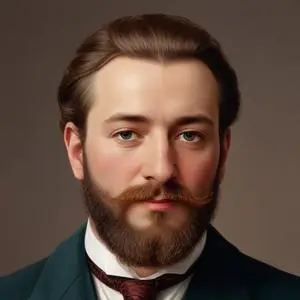
A renowned Pre-Raphaelite artist, famous for his exquisite and intricate paintings, particularly "Ophelia" and "Christ in the House of His Parents", which showcased his mastery of color and detail.
John Everett Millais was a renowned English painter and illustrator who co-founded the Pre-Raphaelite Brotherhood, a revolutionary art movement that sought to revive the stylistic grandeur of the early Renaissance. He is best known for his exquisite attention to detail, vivid colors, and poignant depictions of Victorian life, which continue to captivate art lovers to this day.
Born on June 8, 1829, in Southampton, England, Millais was a child prodigy who began his artistic training at the tender age of nine. He was accepted into the Royal Academy Schools at just eleven, becoming the youngest student to ever enroll. Under the tutelage of Charles Lock Eastlake, Millais developed his skills and eventually became a prominent figure in the art world.
In 1848, Millais co-founded the Pre-Raphaelite Brotherhood with Dante Gabriel Rossetti and William Holman Hunt. This group of artists sought to challenge the traditional art establishment by promoting a return to the techniques and ideals of the early Renaissance. The movement's emphasis on naturalism, detail, and emotional intensity would come to define Millais' work.
By the mid-1850s, Millais began to move away from the Pre-Raphaelite style, adopting a more realistic approach that would propel him to even greater success. However, this shift was met with criticism from some, who saw it as a commercial sellout.
Millais' personal life was marked by a scandalous marriage to Effie Ruskin, the former wife of John Ruskin, a prominent art critic and supporter of Millais' early work. The annulment of Ruskin's marriage and Effie's subsequent marriage to Millais was a highly publicized affair. Despite the controversy, Effie became a devoted promoter of Millais' work, and together they navigated the art world with skill and grace.
Throughout his career, Millais amassed a considerable fortune, earning him the title of one of the wealthiest artists of his time. His later works, though initially criticized by some, have come to be reevaluated in recent decades, revealing a visionary who predicted the art world of the present.
Millais' influence on modern art is undeniable. His pioneering work in the Pre-Raphaelite Brotherhood paved the way for future art movements, including Symbolism, Art Nouveau, and Surrealism. His emphasis on realism and attention to detail has inspired generations of artists, from the Impressionists to contemporary painters.
Today, Millais' legacy extends beyond the art world. His paintings continue to captivate audiences, offering a glimpse into the lives and values of the Victorian era. As a testament to his enduring appeal, Millais' works can be found in prominent museums and galleries around the world, including the Tate Britain and the National Gallery.
Born in 1828
A Victorian-era poet and painter who founded the Pre-Raphaelite Brotherhood, creating dreamlike, sensual works that explored themes of love, beauty, and mortality.
Born in 1827
A British soldier-turned-artist, he co-founded the Pre-Raphaelite Brotherhood, creating vivid, symbolic, and emotionally charged paintings that explored themes of faith, morality, and beauty.
Born in 1833
A leading figure in the Pre-Raphaelite movement, creating dreamlike, romantic, and mythological paintings that captivated the Victorian era. His works continue to inspire artists, designers, and writers to this day.
Born in 1819
A prominent art critic and social reformer who championed the Pre-Raphaelite movement and advocated for social justice, leaving a lasting impact on art, architecture, and literature.
Born in 1830
A renowned Victorian-era poet and author, celebrated for her lyrical and symbolic poetry, particularly "The Goblin Market and Other Poems" and "The Prince's Progress".
Born in 1834
A renowned artist and writer who revolutionized the Arts and Crafts movement with his stunning textiles, poetry, and novels, leaving a lasting impact on Victorian-era aesthetics.
Born in 1821
A French-English soldier and painter who created vivid, detailed, and emotive works that captured the essence of Victorian-era England, particularly with his masterpiece "The Last of England".
