


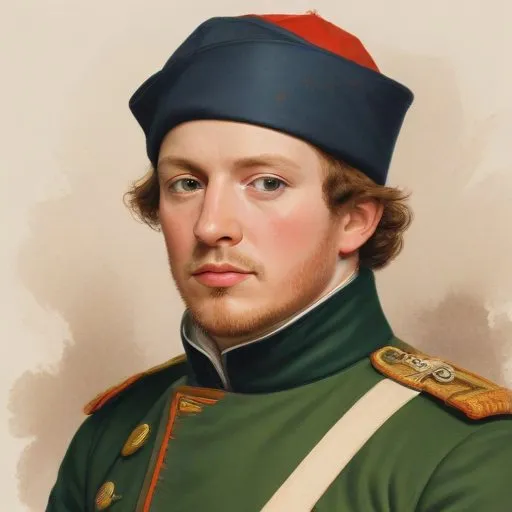
A French-English soldier and painter who created vivid, detailed, and emotive works that captured the essence of Victorian-era England, particularly with his masterpiece "The Last of England".
Ford Madox Brown was a renowned British painter, celebrated for his distinctive and thought-provoking works that embodied the Pre-Raphaelite style. His most iconic piece, "Work" (1852-1865), is a testament to his ability to create powerful and emotionally charged art that continues to inspire generations of artists and art enthusiasts.
Born on April 16, 1821, in Calais, France, Brown was the grandson of John Brown, a prominent medical theorist, and the great-grandson of a Scottish laborer. His father, Ford Brown, served as a purser in the Royal Navy, and the family's frequent relocations influenced Brown's early life and education.
Despite limited financial resources, Brown's parents encouraged his artistic talent, which was evident from a young age. He began by copying Old Master prints, and later studied at the academies in Bruges, Ghent, and Antwerp, under the guidance of esteemed artists such as Albert Gregorius and Gustaf Wappers.
Brown's artistic style was deeply rooted in the Pre-Raphaelite movement, which emerged in the mid-19th century. This movement sought to challenge the traditional approaches to art, emphasizing detail, color, and emotional depth. Brown's work, characterized by its graphic and often Hogarthian style, resonated with the movement's ideals and earned him recognition as a prominent Pre-Raphaelite painter.
Brown's oeuvre is marked by several notable works that showcase his mastery of the Pre-Raphaelite style. Some of his most celebrated pieces include:
Ford Madox Brown's contribution to the Pre-Raphaelite movement and his innovative approach to art have had a lasting impact on the art world. His work has inspired generations of artists, from the Arts and Crafts movement to modern-day practitioners. Today, Brown's paintings are held in high esteem, with many housed in prominent museums and galleries, including the Tate Gallery.
As a testament to his enduring influence, Brown's art continues to captivate audiences, offering a unique window into the social, cultural, and historical context of his time. His legacy serves as a reminder of the power of art to inspire, educate, and provoke, ensuring his place as a pioneering figure in the world of British art.
Brown's personal life was marked by tragedy, with the loss of his mother in 1839, his sister in 1840, and his father in 1842. Despite these challenges, he continued to pursue his artistic passion, eventually marrying Emma Hill in 1841 and going on to have two children.
Throughout his life, Brown remained committed to his craft, constantly seeking to innovate and push the boundaries of artistic expression. His dedication to his art and his role in shaping the Pre-Raphaelite movement have cemented his place as a celebrated figure in the history of British art.
Born in 1829
A renowned Pre-Raphaelite artist, famous for his exquisite and intricate paintings, particularly "Ophelia" and "Christ in the House of His Parents", which showcased his mastery of color and detail.
Born in 1827
A British soldier-turned-artist, he co-founded the Pre-Raphaelite Brotherhood, creating vivid, symbolic, and emotionally charged paintings that explored themes of faith, morality, and beauty.
Born in 1833
A leading figure in the Pre-Raphaelite movement, creating dreamlike, romantic, and mythological paintings that captivated the Victorian era. His works continue to inspire artists, designers, and writers to this day.
Born in 1828
A Victorian-era poet and painter who founded the Pre-Raphaelite Brotherhood, creating dreamlike, sensual works that explored themes of love, beauty, and mortality.
Born in 1834
A renowned artist and writer who revolutionized the Arts and Crafts movement with his stunning textiles, poetry, and novels, leaving a lasting impact on Victorian-era aesthetics.
Born in 1819
A prominent art critic and social reformer who championed the Pre-Raphaelite movement and advocated for social justice, leaving a lasting impact on art, architecture, and literature.
Born in 1830
A renowned Victorian-era poet and author, celebrated for her lyrical and symbolic poetry, particularly "The Goblin Market and Other Poems" and "The Prince's Progress".
Born in 1837
A prominent Victorian-era writer, known for his poetic works that explored themes of beauty, death, and the human condition, with a distinctive style that blended sensuality and symbolism.
