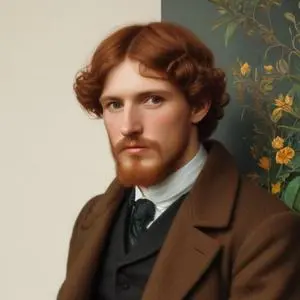
Sir Edward Burne-Jones: The Visionary Painter and Designer of the Pre-Raphaelite Brotherhood
A Master of Dreamlike Landscapes and Mythological Themes
Sir Edward Burne-Jones is renowned for his enchanting and intricate oil paintings that transport viewers to mystical realms, showcasing his unique blend of medieval romanticism and Aesthetic Movement sensibilities. As a key figure of the Pre-Raphaelite Brotherhood, Burne-Jones' work is characterized by its intense emotional depth, rich symbolism, and meticulous attention to detail.
Early Life and Influences
Born in Birmingham, England on August 28, 1833, Burne-Jones was raised by his father, Edward Richard Jones, after his mother's untimely death. He developed a strong affinity for art and literature, influenced by his father's storytelling and the artistic pursuits of his friends. Burne-Jones' early education at the Birmingham School of Art and Exeter College, Oxford, laid the foundation for his future artistic endeavors.
Artistic Career and Key Works
Burne-Jones' artistic trajectory is marked by his association with the Pre-Raphaelite Brotherhood, a group of artists dedicated to reviving the artistic principles of the early Renaissance. His early paintings, such as
The Beguiling of Merlin (1872-1874), demonstrate the influence of
Dante Gabriel Rossetti's style. However, by the 1870s, Burne-Jones had developed his distinctive style, characterized by dreamlike landscapes, mythological themes, and exquisite detail.
Some of his notable works include:
- The Star of Bethlehem (1891), a painting now housed at the Birmingham Museum and Art Gallery
- The Wheel of Fortune (1885), a series of paintings exploring the themes of fate and destiny
- Pygmalion and the Image (1875-1878), a masterpiece showcasing Burne-Jones' skill in storytelling through art
Design and Decorative Arts
Burne-Jones was an accomplished designer, and his work extended beyond painting to various forms of decorative art. He was a founding partner of Morris, Marshall, Faulkner & Co., a company established by
William Morris, where he designed ceramics, jewelry, tapestries, and stained glass windows. His designs for stained glass windows, in particular, remain a testament to his creative genius and continue to adorn churches across the UK, US, and Australia.
Legacy and Impact
Burne-Jones' contribution to the world of art and design is immeasurable. He played a significant role in popularizing the Aesthetic Movement, which emphasized the importance of beauty and sensuality in art. His work continues to inspire artists, designers, and art enthusiasts alike, with his paintings and designs remaining a testament to his boundless creativity and imagination.
Awards and Honors
Throughout his career, Burne-Jones received numerous accolades, including:
- Appointed Baronet in 1894
- Member of the Royal Academy of Arts
- Recipient of the Gold Medal at the 1889 Paris Exposition Universelle
Personal Life and Relationships
Burne-Jones' personal life was marked by his strong bond with William Morris, with whom he shared a lifelong friendship and professional partnership. His relationships with his models and muses, including Maria Zambaco and Georgiana Burne-Jones, inspired many of his paintings and provided a glimpse into his emotional depth.
Conclusion
Sir Edward Burne-Jones' artistic legacy continues to enchant and inspire generations of art lovers. His dreamlike paintings, exquisite designs, and contributions to the Pre-Raphaelite Brotherhood and Aesthetic Movement have cemented his place as one of the most celebrated artists of the 19th century.
FAQ
Who was Edward Burne-Jones?
Edward Burne-Jones was an English artist of the Pre-Raphaelite movement, born on August 28, 1833, in Edgbaston, Birmingham, England and died on June 17, 1898.
What was Edward Burne-Jones style of art?
Edward Burne-Jones style of art was characterized by its dreamlike quality, rich colors, and detailed illustrations. He was heavily influenced by medieval art and literature.
What was Edward Burne-Jones role in the Pre-Raphaelite movement?
Edward Burne-Jones was a key figure in the Pre-Raphaelite movement, a group of artists who rejected the dominant art styles of the time and sought to revive the techniques and spirit of the early Renaissance.
What was Edward Burne-Jones contribution to stained glass art?
Edward Burne-Jones made significant contributions to the art of stained glass, designing several notable stained glass windows for churches and cathedrals across England.
What is Edward Burne-Jones legacy in art?
Edward Burne-Jones legacy in art lies in his stunning and evocative paintings, which continue to inspire and captivate audiences to this day. He is remembered as one of the leading figures of the Pre-Raphaelite movement.