


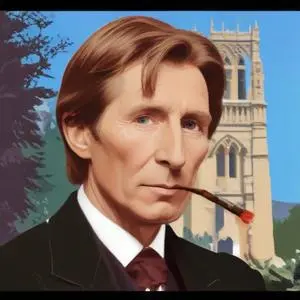
A prominent art critic and social reformer who championed the Pre-Raphaelite movement and advocated for social justice, leaving a lasting impact on art, architecture, and literature.
John Ruskin, a renowned English writer, philosopher, art historian, and critic, is best known for his influential works on art, architecture, and social reform, which continue to inspire and educate generations. As a polymath, Ruskin's contributions span multiple fields, including geology, ornithology, literature, education, and political economy, making him one of the most versatile thinkers of the Victorian era.
Born on February 8, 1819, in London, England, Ruskin was raised in a family that valued education and the arts. His father, a wealthy wine merchant, encouraged his son's interest in literature and art from an early age. Ruskin went on to study at Christ Church, Oxford, where he developed a deep appreciation for the works of William Wordsworth and the Romantic movement.
Ruskin's writing career began with the publication of his first volume of Modern Painters in 1843, an extended essay that defended the work of J.M.W. Turner and emphasized the importance of truth to nature in art. This work brought him widespread attention and critical acclaim, establishing him as a leading art critic of his time.
In the 1850s, Ruskin championed the Pre-Raphaelite movement, a group of artists who sought to revive the style of the early Renaissance. His support and encouragement helped to establish the movement, which included artists such as Dante Gabriel Rossetti and William Holman Hunt. Ruskin's focus gradually shifted from art criticism to social and political issues, as seen in his influential work Unto This Last (1860-1862), which explored the relationship between art, labor, and social justice.
In 1869, Ruskin became the first Slade Professor of Fine Art at the University of Oxford, where he established the Ruskin School of Drawing. He continued to write and teach, producing works such as The Eagle's Nest (1872) and Fors Clavigera (1871-1884), a series of letters that explored various topics, including art, literature, and social issues.
Ruskin's ideas and contributions have had a lasting impact on art, architecture, and social reform. His emphasis on the importance of craftsmanship, the value of nature, and the need for social justice continue to inspire artists, architects, and activists today. As a pioneer of the arts and crafts movement, Ruskin's legacy can be seen in the works of William Morris, Walter Crane, and other prominent artists of the late 19th and early 20th centuries.
Ruskin's philosophical contributions include his concept of the "pathetic fallacy," which posits that human emotions and experiences are inseparable from our perception of nature. He also believed in the importance of art as a means of social commentary and critique, advocating for the role of the artist as a moral guide and social reformer.
"The highest reward for a person's toil is not what they get for it, but what they become by it."
Ruskin's work and ideas were shaped by the social, cultural, and economic changes of the Victorian era. His emphasis on the importance of art, craftsmanship, and social justice continues to resonate with contemporary audiences, making him a relevant and important figure in the history of art and thought.
Ruskin's ideas and contributions have had a lasting impact on modern society, influencing fields such as art, architecture, education, and social reform. His emphasis on the importance of craftsmanship, sustainability, and social justice continues to inspire and inform contemporary debates and initiatives.
Born in 1697
A pioneering artist and social commentator, known for his witty and insightful depictions of 18th-century English life, morality, and politics through his paintings and engravings.
Born in 1727
A prominent 18th-century painter of landscapes and portraits, capturing the essence of British aristocracy and gentry with elegance and refinement.
Born in 1723
A prominent portrait painter and art educator who helped establish the Royal Academy of Arts, known for his influential teachings and masterful depictions of 18th-century British aristocracy.
Born in 1770
A major Romantic poet, known for his focus on nature, emotion, and the human experience, creating works that evoke a sense of wonder and connection to the natural world.
Born in 1772
A leading figure of the Romantic movement, he crafted vivid, imaginative poetry and explored the human experience through his writing and philosophical ideas. His works continue to inspire and influence literature and art to this day.
Born in 1788
Romantic poet and playwright celebrated for passionate, expressive works that explored themes of love, freedom, and the human condition.
Born in 1792
Romantic-era writer of lyrical poetry and Gothic dramas that explored the human condition, freedom, and the beauty of nature.
Born in 1797
Author of Gothic novels, particularly the iconic "Frankenstein", which has become a cultural phenomenon and influenced countless adaptations and reinterpretations.
