


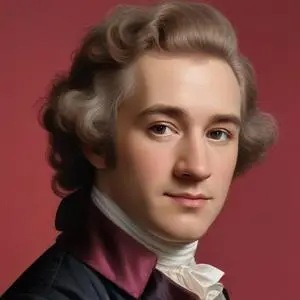
A prominent portrait painter and art educator who helped establish the Royal Academy of Arts, known for his influential teachings and masterful depictions of 18th-century British aristocracy.
Regarded by many as one of the most influential portrait painters of the 18th century, Sir Joshua Reynolds was a master of capturing the subtleties of human emotion on canvas. His innovative approach to portraiture, characterized by a focus on idealization and the "Grand Style," earned him widespread acclaim and numerous prestigious commissions.
Born on July 16, 1723, in Plympton, Devon, Reynolds was the third son of Reverend Samuel Reynolds, master of the Plympton Free Grammar School. His family's emphasis on education and the arts instilled in him a deep appreciation for literature and philosophy, which would later inform his artistic style. His sister, Mary Palmer, an author and enthusiast of drawing, played a significant role in nurturing his early interest in art.
In 1740, Reynolds began his apprenticeship with portrait painter Thomas Hudson, thanks in part to his sister's financial support. This formative experience laid the foundation for his future success. Nine years later, Mary Palmer again came to his aid, providing the necessary funds for Reynolds to travel to Italy, where he immersed himself in the works of the Old Masters and developed his signature style.
Reynolds' artistic philosophy was deeply rooted in the concept of idealization, which involved capturing the essence of his subjects rather than striving for precise realism. This approach, which he termed the "Grand Style," was influenced by his study of classical literature and philosophy, as well as the works of Renaissance masters like Leonardo da Vinci.
Throughout his illustrious career, Reynolds created numerous masterpieces that solidified his position as a leading portraitist of his time. Some of his most notable works include:
In 1768, Reynolds was instrumental in founding the Royal Academy of Arts, an institution dedicated to promoting the arts and providing a platform for artists to showcase their work. He served as the Academy's first president, a testament to his stature and influence in the art world.
Sir Joshua Reynolds' impact on the art world extends far beyond his own remarkable body of work. He paved the way for future generations of artists, inspiring countless painters and portraitists with his innovative approach and mastery of the craft. Today, his legacy continues to inspire and captivate art enthusiasts around the world.
Sir Joshua Reynolds' remarkable life and career serve as a testament to the power of artistic innovation and dedication. His contributions to the world of portraiture continue to inspire and influence artists to this day, solidifying his position as one of the greatest painters of the 18th century.
Born in 1727
A prominent 18th-century painter of landscapes and portraits, capturing the essence of British aristocracy and gentry with elegance and refinement.
Born in 1697
A pioneering artist and social commentator, known for his witty and insightful depictions of 18th-century English life, morality, and politics through his paintings and engravings.
Born in 1776
A Romantic-era painter celebrated for capturing the essence of the English countryside through serene, naturalistic landscapes, often featuring skies and clouds.
72 Years Old
A Sri Lankan-Scottish swimmer who won multiple Olympic and Commonwealth Games medals, setting world records in the 200m breaststroke and 4x100m medley relay events.
Born in 1756
A Scottish portrait painter renowned for capturing the subtleties of human expression and character in his vivid, psychologically astute works, often featuring members of the Scottish aristocracy.
Born in 1713
A prominent 18th-century portrait painter, capturing the likenesses of British aristocracy and intellectuals with remarkable sensitivity and realism. His works continue to adorn galleries and stately homes today.
Born in 1907
The 43rd Governor of Michigan was a prominent businessman and politician who played a significant role in shaping the state's economy and politics. He's most known for his innovative leadership and advocacy for civil rights.
Born in 1561
A 16th-17th century Renaissance figure who pioneered the scientific method and empiricism, and served as a prominent government official.
