


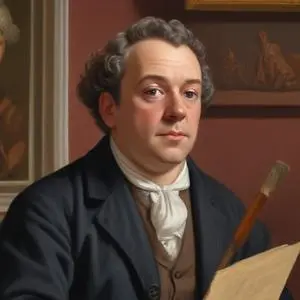
A pioneering artist and social commentator, known for his witty and insightful depictions of 18th-century English life, morality, and politics through his paintings and engravings.
William Hogarth, a renowned English painter, engraver, and pictorial satirist, is celebrated for his biting social commentaries and vivid portrayals of 18th-century London life. His iconic series, A Harlot's Progress, A Rake's Progress, and Marriage à-la-mode, continue to influence art, literature, and popular culture to this day.
Born on November 10, 1697, in London, Hogarth was the son of Richard Hogarth, a struggling Latin school teacher, and Anne Gibbons. His early life was marked by financial instability, with his father imprisoned for debt when Hogarth was just a teenager. This experience would later inform his art, imbuing it with a sense of social commentary and satire.
Hogarth began his artistic training as an apprentice to engraver Ellis Gamble, where he honed his skills in engraving trade cards and other commercial materials. He soon developed a passion for satirical art, drawing inspiration from French and Italian masters. His unique style, characterized by vivid colors, precise lines, and biting wit, quickly gained popularity, and his works were mass-produced as prints during his lifetime.
Hogarth's innovative style and biting satire have influenced generations of artists, writers, and social commentators. His work has been praised for its acute observations of human nature, its mastery of composition and color, and its unwavering commitment to social critique.
Hogarth's art embodies a deep understanding of human nature, revealing the contradictions and flaws of his contemporaries. His works often explore themes of morality, class, and social status, offering a searing commentary on the social ills of his time.
Hogarth's influence extends far beyond the art world. His satirical style has inspired countless cartoons, caricatures, and editorial illustrations, earning him the epithet "the father of British satire." His work continues to resonate with modern audiences, offering a timeless commentary on human nature and the social consequences of our actions.
"The line of beauty is the serpent line, or the waving line, which varies its direction every moment, as the serpent's body does in its motion."
— William Hogarth, The Analysis of Beauty (1745)
Explore Hogarth's life and art through a visual timeline, featuring key milestones, influential works, and personal anecdotes.
| 1697 | William Hogarth born in London |
| 1709 | Apprenticed to engraver Ellis Gamble |
| 1714 | Father imprisoned for debt |
| 1720s | Began producing satirical prints and paintings |
| 1730s | Refined his style, producing iconic series like A Harlot's Progress and A Rake's Progress |
| 1745 | Published The Analysis of Beauty |
| 1764 | Died on October 26, at the age of 66 |
William Hogarth's life and art continue to captivate audiences, offering a rich tapestry of social commentary, satire, and artistic innovation. As a pioneering figure in British art, his legacy inspires generations to come.
Born in 1707
Wrote influential and satirical novels of manners, such as "Tom Jones", that explored the social and moral issues of 18th-century England.
Born in 1846
A Nigerian priest and historian who wrote the first comprehensive history of the Yoruba people, providing valuable insights into their culture and traditions.
Born in 1723
A prominent portrait painter and art educator who helped establish the Royal Academy of Arts, known for his influential teachings and masterful depictions of 18th-century British aristocracy.
Born in 1727
A prominent 18th-century painter of landscapes and portraits, capturing the essence of British aristocracy and gentry with elegance and refinement.
Born in 1907
The 43rd Governor of Michigan was a prominent businessman and politician who played a significant role in shaping the state's economy and politics. He's most known for his innovative leadership and advocacy for civil rights.
Born in 1713
A prominent 18th-century portrait painter, capturing the likenesses of British aristocracy and intellectuals with remarkable sensitivity and realism. His works continue to adorn galleries and stately homes today.
Born in 1732
A prolific Rococo painter and etcher, renowned for his delicate, whimsical, and often erotic works that capture the carefree spirit of 18th-century French aristocracy. His art often featured lush landscapes, gentle colors, and playful scenes of love and leisure.
Born in 1741
A pioneering female artist of the 18th century, known for her exquisite portraits and landscapes that blended Neoclassicism with Rococo elements. Her work adorned the walls of European aristocracy and royalty.
