


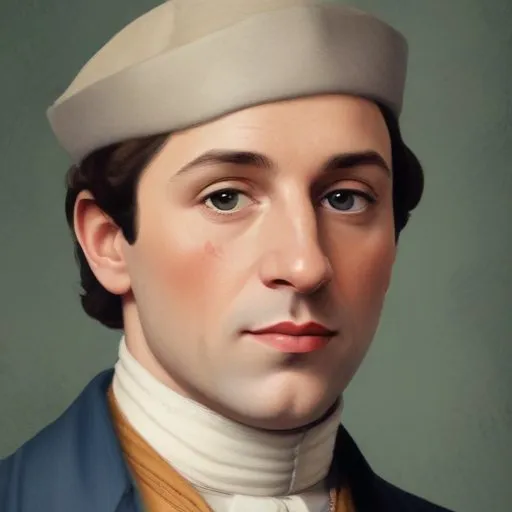
A younger brother of King Charles VI of France, he was a powerful nobleman and military leader who played a key role in the Hundred Years' War. He was also a patron of the arts and literature.
Louis, Duke of Orléans, is renowned for his devout nature, charitable endeavors, and cultural pursuits, earning him the epithets "Louis le Pieux" and "Louis le Génovèse." As a member of the House of Bourbon, he held the prestigious title of First Prince of the Blood, Premier Prince du Sang, and Duke of Orléans.
Born on August 4, 1703, at the Palace of Versailles, Louis was the only son of Philippe II, Duke of Orléans, and his wife, Françoise Marie de Bourbon, the youngest legitimized daughter of Louis XIV and his mistress Madame de Montespan. As the heir to the Orléans fortune and titles, he was bestowed the courtesy title of Duke of Chartres.
His maternal grandfather, King Louis XIV of France, granted him the allowance reserved for the First Prince of the Blood, a rank he would eventually hold. Louis was raised by his mother and grandmother, Elizabeth Charlotte of the Palatinate, under the tutelage of Nicolas-Hubert Mongault, the illegitimate son of Jean-Baptiste Colbert de Saint-Pouange.
Louis was known for his piety and charitable nature, which earned him the admiration of his contemporaries. He was particularly devoted to the Catholic Church and supported various charitable institutions throughout his life.
His charitable endeavors were reflected in his support for the poor and the sick. He was a patron of the Hospice des Incurables, a hospital for the incurably ill, and provided financial aid to various other charitable organizations.
Louis was a cultured and refined individual, with a deep appreciation for the arts. He was a patron of several artists, including the renowned painter, François Boucher.
His love for literature and music led him to establish a private theater and opera house within the Palace of Orléans, where he would host performances for the French court.
Louis lived a life of service and devotion, devoting himself to his family, his faith, and his country. He played a significant role in the Regency period, following the death of his maternal grandfather, Louis XIV, in 1715.
During this time, his father, Philippe II, Duke of Orléans, served as regent for the young King Louis XV, and Louis, as the First Prince of the Blood, played a supporting role in the governance of the country.
Louis, Duke of Orléans, left an indelible mark on French history, through his piety, charity, and cultural pursuits. He embodied the values of a true prince of the blood, serving his family, his country, and his faith with devotion and dedication.
Today, he is remembered as a shining example of a life well-lived, a testament to the enduring power of faith, charity, and culture.
Born in 1674
The Regent of France from 1715 to 1723, known for his cultural and artistic patronage, and his role in shaping the country's politics during a period of significant change.
Born in 1710
The monarch who ruled France from 1715 to 1774, known as the "Sun King's" great-grandson, and remembered for his extravagance, absolutism, and the decline of the French monarchy.
Born in 1674
The Regent of France from 1715 to 1723, known for his cultural and artistic patronage, and his role in shaping the country's politics during a period of significant change.
Born in 1639
A 17th-century master of French tragedy, crafting intricate, psychologically complex dramas that probed the human condition, influencing the development of Western theatre.
Born in 1622
A 17th-century master of comedy, he penned witty plays that satirized the French aristocracy, leaving a lasting impact on Western theater. His works remain widely performed and adapted today.
Born in 1621
A 17th-century master of fables, crafting witty, moral tales that entertain and educate, still widely read and adapted today.
Born in 1636
A 17th-century French poet and critic who advocated for reason and morality in literature, and is known for his influential writings on poetry and aesthetics.
Born in 1668
A renowned Baroque composer and organist, known for his intricate and expressive harpsichord music that showcased his mastery of counterpoint and ornamentation. His works continue to inspire and influence classical music today.
