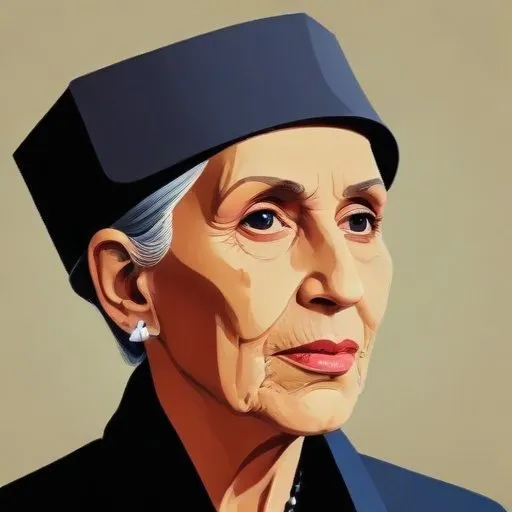
Louise Nevelson: The Visionary Sculptor of Monumental Proportions
Introduction
Louise Nevelson is renowned for her colossal, monochromatic wooden wall pieces and outdoor sculptures that redefine the boundaries of modern art. As a pioneering American sculptor, she has left an indelible mark on the art world, creating intricate, puzzle-like structures that continue to fascinate audiences worldwide.
Early Life and Background
Born as Leah Berliawsky on September 23, 1899, in Pereiaslav, Poltava Governorate, Russian Empire (present-day Kyiv Oblast, Ukraine), Nevelson's family emigrated to the United States in the early 20th century. She learned English at school, while Yiddish was spoken at home. This cultural duality would later influence her artistic style, as she seamlessly blended traditional techniques with modernist experimentation.
Artistic Development and Training
Nevelson's artistic journey began in the early 1930s, when she attended art classes at the Art Students League of New York. Her early work was characterized by experimentation with painting and printing, before she dedicated herself to sculpture. This medium allowed her to explore the intersection of form, texture, and space, culminating in the creation of her signature wooden wall pieces.
Philosophical Contributions and Beliefs
Nevelson's artistic philosophy was rooted in the concept of unity and wholeness. She believed that individual components, when combined, could create a cohesive, harmonious whole. This approach is reflected in her use of monochromatic colors, which emphasizes the unity of form and negates the distractions of color. Her sculptures, often described as "environmental," invite the viewer to engage with the artwork on a deeper level, blurring the boundaries between art and life.
Major Works and Career Highlights
- "Dawn's Forest" (1959): A seminal work that showcases Nevelson's signature style, featuring a series of wooden boxes arranged to create a forest-like environment.
- "Sky Landscape I" (1963): A monumental wall piece that exemplifies Nevelson's ability to create intricate, puzzle-like structures.
- " Atmosphere and Environment" (1969): A groundbreaking exhibition at the Whitney Museum of American Art, which solidified Nevelson's status as a leading figure in American sculpture.
Influence on Modern Society and Pop Culture
Nevelson's innovative approach to sculpture has had a profound impact on modern art and architecture. Her work has inspired generations of artists, architects, and designers, influencing the development of environmental art, installation art, and even urban planning. Furthermore, her monochromatic aesthetic has influenced the world of fashion, with designers incorporating her signature style into their collections.
Awards and Honors
Nevelson's contributions to the art world have been recognized with numerous awards and honors, including:
- Guggenheim Fellowship (1959)
- National Medal of Arts (1979)
- Inducted into the American Academy of Arts and Letters (1983)
Legacy and Historical Context
Louise Nevelson's legacy extends beyond the boundaries of her art. She has played a pivotal role in shaping the course of modern American sculpture, paving the way for future generations of artists. Her influence can be seen in the work of contemporaries such as
Mark di Suvero and
Richard Serra, as well as in the broader cultural landscape. As a testament to her enduring impact, Nevelson's work continues to be exhibited and celebrated worldwide, inspiring new generations of artists, architects, and art enthusiasts alike.
FAQ
What style of art was Louise Nevelson known for?
Louise Nevelson was known for her work in Assemblage art, which involved creating sculptures from found objects and materials.
What was Louise Nevelsons most famous work?
Louise Nevelsons most famous work is her Black Paintings, a series of sculptures made from found wood objects painted black, which explore themes of abstraction and space.
What was Louise Nevelsons early career like?
Louise Nevelson studied art in New York City and began her career as a painter before turning to sculpture in the 1950s. She was influenced by Cubism and Surrealism.
How did Louise Nevelsons work challenge traditional notions of art?
Louise Nevelsons work challenged traditional notions of art by using found materials and exploring new ways of creating sculptures that blurred the line between art and everyday objects.
What was Louise Nevelsons legacy after her death?
Louise Nevelsons legacy continues to be celebrated as a pioneering figure in Assemblage art and a groundbreaking female artist. Her work is held in high esteem and is exhibited in museums around the world.