


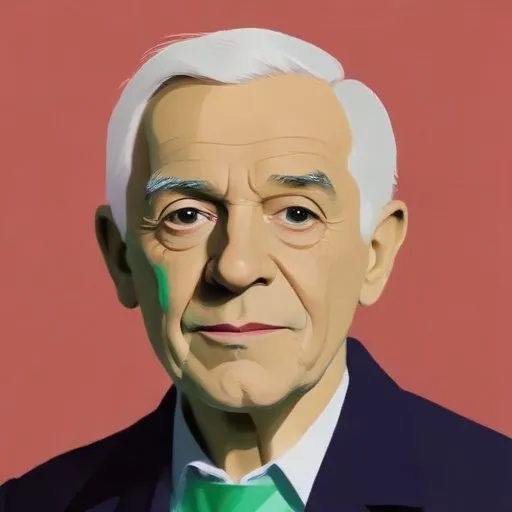
A pioneering Irish artist celebrated for his vibrant, expressive portraits of literary and historical figures, blending modernist techniques with a deep sense of Irish heritage.
Louis le Brocquy was a renowned Irish painter, celebrated for his evocative Portrait Heads of literary figures and fellow artists, as well as his thought-provoking Tinker subjects and Grey period Family paintings. With a career spanning over seven decades, le Brocquy's work has been recognized globally, earning him a place among the most esteemed artists of his time.
Born on November 10, 1916, in Dublin, Ireland, le Brocquy was the son of Albert and Sybil le Brocquy. His sister, Melanie le Brocquy, would go on to become a sculptor. Le Brocquy's educational background included St. Gerard's School, Kevin Street Technical School (where he studied chemistry in 1934), and Trinity College Dublin.
In 1956, le Brocquy represented Ireland at the prestigious Venice Biennale, where he was awarded the Premio Acquisito Internationale. This recognition led to his inclusion in the historic exhibition Fifty Years of Modern Art at the Brussels World Fair in 1958. The same year, he married Irish painter Anne Madden and relocated to the French Midi.
Le Brocquy's work is characterized by its unique blend of modernist and figurative elements. His Portrait Heads, which include subjects such as William Butler Yeats, James Joyce, Samuel Beckett, Francis Bacon, and Seamus Heaney, showcase his ability to capture the essence of his subjects. His Tinker subjects, inspired by the Irish Traveller community, and Grey period Family paintings, demonstrate his fascination with the human experience.
Throughout his career, le Brocquy received numerous accolades, including the Premio Acquisito Internationale (1956) and the honorary degree of Doctor of Fine Arts from the National University of Ireland (2007). He was also the first and only painter to be included in the Permanent Irish Collection of the National Gallery of Ireland during his lifetime.
Le Brocquy's work can be found in prominent public collections, including the Guggenheim, New York, and the Tate Modern, London. His legacy extends beyond the art world, as his paintings have commanded prices in excess of £1 million during his lifetime, cementing his position among the most successful British and Irish artists of his generation.
Le Brocquy's personal life was marked by two marriages, first to Jean Stoney from 1938 to 1948, with whom he had a daughter, Seyre, and then to Anne Madden in 1956. He passed away on April 25, 2012, leaving behind a rich artistic heritage.
"The most important thing in art is the thing that cannot be explained." - Louis le Brocquy
Le Brocquy's work continues to inspire artists, writers, and thinkers around the world. His unique perspective and artistic style have left an indelible mark on the art world, ensuring his legacy will be remembered for generations to come.
Born in 1906
A pioneering absurdist writer who crafted avant-garde novels, poems, and plays that probed the human condition, often with dark humor and existential themes. His works are renowned for their complexity and influence on modern literature.
Born in 1561
A 16th-17th century Renaissance figure who pioneered the scientific method and empiricism, and served as a prominent government official.
Born in 1865
A renowned Irish wordsmith and dramatist, celebrated for his mystical and nationalistic verse that explores the human condition, as well as his contributions to the Irish Literary Revival.
Born in 1907
A leading figure of the 1930s poetic movement, known for his lyrical and introspective verse that explored themes of love, nature, and the human condition.
