


Developed the first practical infrared night vision device, allowing for nighttime surveillance and reconnaissance during World War II. This innovation revolutionized military tactics and surveillance.
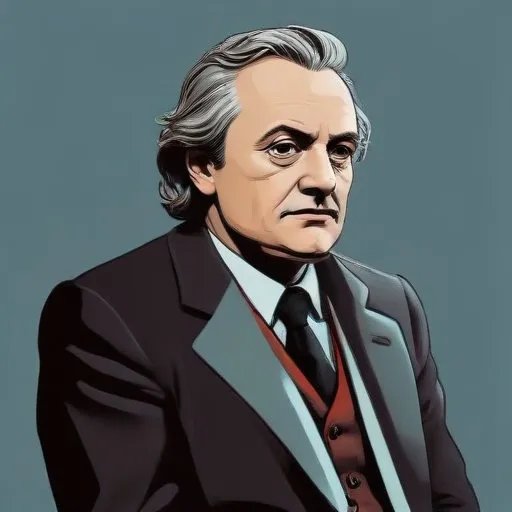
Ludwig Holborn, a German physicist, is renowned for his groundbreaking work in the measurement of high temperatures using optical pyrometry. His innovative approach revolutionized the field of thermometry, enabling precise temperature measurements that transformed various industries.
Born on September 29, 1860, in Weende, Göttingen, Holborn was the son of Louis and Louise (née Oelsen). He pursued his education at the Realschule and later at the University of Göttingen, where he studied natural sciences.
After completing his studies, Holborn taught mathematics and physics at the University of Göttingen, while also serving as an assistant to Ernst Christian Julius Schering at the Göttingen geomagnetic observatory (Gauschen Erdmagnetischen Observatorium). In 1887, he received his doctorate for his research on the daily variation of magnetic declination.
In 1890, Holborn joined the Physikalisch-Technische Reichsanstalt ( PTR), where he worked alongside the esteemed Hermann von Helmholtz in Charlottenberg. During this period, he designed a torsion magnetometer in collaboration with F.W.G. Kohlrausch in 1903. This invention marked a significant milestone in the development of precision measurement tools.
In 1901, Holborn, in collaboration with Ferdinand Kurlbaum, designed the Holborn-Kurlbaum pyrometer, a pioneering optical pyrometer that enabled the accurate measurement of high temperatures. This innovative device worked by matching the colors of an object heated with a known reference filament until it became invisible. The Holborn-Kurlbaum pyrometer became a benchmark for temperature measurement, transforming industries such as metallurgy, glass-making, and ceramics.
Holborn married Helene (née Bumann), and they had three children together. His daughter, Louise Holborn, went on to become a professor of politics at the Connecticut College for Women, while his son, Hajo Holborn, became a historian at Yale University.
Holborn's contributions to the field of thermometry have had a lasting impact on modern society. His work paved the way for further innovations in temperature measurement, enabling significant advancements in various scientific and industrial fields. Today, Ludwig Holborn is remembered as a pioneer in the measurement of high temperatures, and his legacy continues to inspire new generations of scientists and engineers.
Throughout his career, Holborn received numerous awards and honors for his outstanding contributions to the field of physics. His work continues to be recognized and celebrated as a testament to his pioneering spirit and dedication to scientific excellence.
In conclusion, Ludwig Holborn's groundbreaking work in the measurement of high temperatures has left an indelible mark on the scientific community. His innovative approach, coupled with his passion for precision, has enabled significant advancements in various fields, cementing his place as one of the most influential physicists of his time.
Born in 1879
A brilliant physicist who developed the theory of relativity and is considered one of the most influential scientists of the 20th century, known for his groundbreaking work in physics and mathematics.
Born in 1858
A pioneer in quantum theory, he introduced the concept of the Planck constant, revolutionizing our understanding of energy and matter.
Born in 1901
A pioneer in quantum mechanics, he formulated the uncertainty principle, which revolutionized our understanding of the atomic world. His groundbreaking work reshaped modern physics.
Born in 1885
A pioneer in quantum mechanics, he introduced the concept of wave-particle duality, revolutionizing our understanding of atomic structure. His philosophical approach to science also explored the nature of reality and human understanding.
Born in 1864
Developed groundbreaking geometric methods that transformed our understanding of space and time, and his work laid the foundation for Einstein's theory of relativity.
Born in 1882
A pioneer in quantum mechanics, he developed the statistical interpretation of wave functions, revolutionizing our understanding of the atomic world. His work laid the foundation for modern physics and chemistry.
Born in 1868
Developed the Sommerfeld model, a quantum mechanical model of electrons in metals, and made significant contributions to the development of quantum mechanics and relativity. His work laid the foundation for modern solid-state physics.
